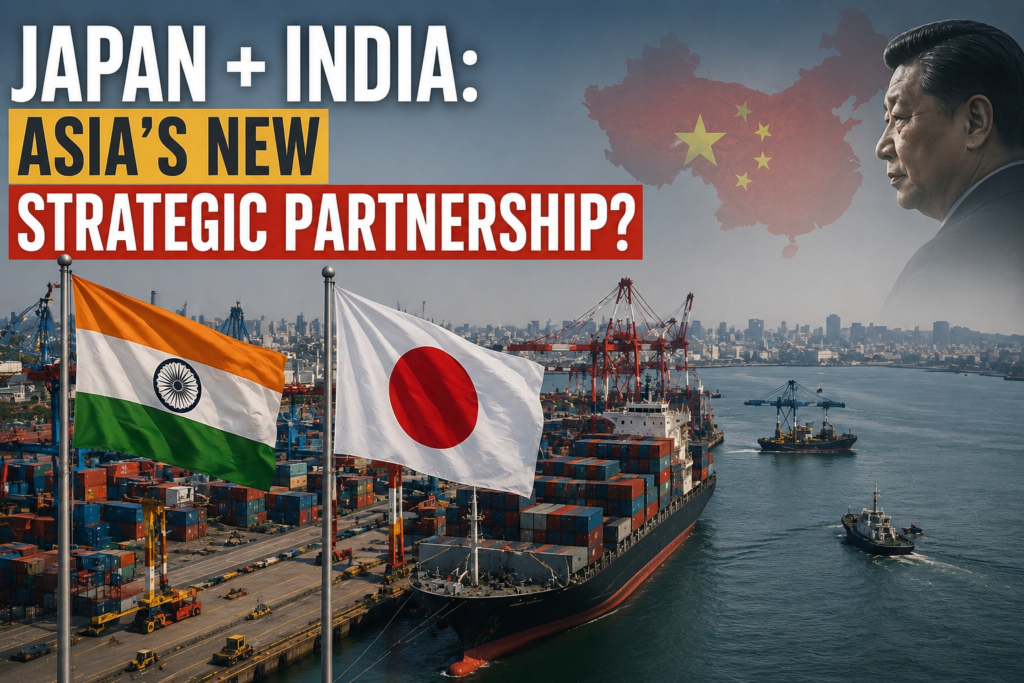
For much of the past two decades, discussions about Asia’s strategic future have revolved around China’s rise. Its manufacturing dominance, expanding military capabilities, and growing diplomatic influence have reshaped everything from corporate investment decisions to national security strategies. Whether governments were discussing trade, technology, or regional security, China increasingly became part of the calculation.
That assumption is now being tested—not because China is becoming less important, but because many countries are becoming less comfortable depending so heavily on any single economic ecosystem.
The latest agreements between Japan and India are best understood through that lens.
On the surface, the visit looked familiar. Leaders met, joint statements were issued, and officials reaffirmed their commitment to stronger ties. Diplomatic calendars are full of such meetings, and most fade from international attention within days.
This one didn’t.
The reason wasn’t a single headline announcement. It was the collection of subjects on the table. Artificial intelligence. Semiconductor manufacturing. Critical minerals. Clean energy. Digital infrastructure. Maritime security. Defense cooperation. Supply-chain resilience.
Individually, each area matters.
Together, they reveal how governments increasingly define strategic power.
Only a decade ago, these industries were discussed largely in terms of economic growth and private investment. Today, they are treated as matters of national security. A shortage of semiconductor chips can disrupt automobile production across continents. Control over critical minerals influences the future of electric vehicles and battery manufacturing. Undersea cables and digital infrastructure have become as strategically significant as ports and shipping lanes.
The boundaries between economics and security have become increasingly difficult to separate.
Ironically, globalization created many of the dependencies governments are now trying to reduce. The same integrated supply chains that drove decades of economic efficiency also exposed how vulnerable countries could become when a single disruption rippled across the global economy.
The COVID-19 pandemic made that vulnerability impossible to ignore. So did subsequent geopolitical tensions, sanctions, and disruptions to major shipping routes. Businesses that once optimized almost entirely for cost now place growing value on resilience. Governments have followed a similar path.
The geography of globalization is being quietly redrawn—not through dramatic announcements, but through thousands of investment decisions that rarely make front-page news.
That broader shift gives new meaning to the growing partnership between Japan and India.
Neither country is attempting to reshape the regional order overnight. Yet both appear to recognize that economic influence over the next twenty years will depend as much on trusted industrial partnerships as on traditional diplomacy.
That helps explain why China is paying close attention.
What Actually Happened?
The recent discussions between Japan and India did not revolve around a single flagship agreement. Instead, they expanded cooperation across several industries that are likely to define economic competitiveness over the coming decades.
The agenda included artificial intelligence, semiconductor manufacturing, critical minerals, clean energy, digital infrastructure, advanced manufacturing, maritime security, defense cooperation, and stronger supply chains. Both governments also encouraged greater private-sector investment while reaffirming their commitment to long-term economic collaboration.
Most of these priorities are not new.
Japan has been one of India’s most important development partners for years through Official Development Assistance (ODA), financing infrastructure projects, industrial corridors, and urban transport systems. The Mumbai–Ahmedabad High-Speed Rail project remains one of the clearest symbols of that relationship, while the Western Dedicated Freight Corridor reflects years of cooperation aimed at improving India’s industrial logistics.
Japanese companies have steadily expanded their presence as well. Suzuki helped transform India’s passenger car market decades ago, Toyota continues to deepen its manufacturing footprint, and numerous Japanese suppliers now form part of India’s broader industrial ecosystem.
The latest discussions build on that foundation rather than replacing it.
That continuity is easy to overlook because geopolitical stories often focus on summits and announcements. In reality, strategic partnerships usually develop much more gradually. Large investment decisions, technology transfers, and industrial cooperation rarely produce dramatic headlines, but they often have longer-lasting consequences than political speeches.
One meeting rarely changes the strategic balance in Asia.
A series of connected decisions over many years sometimes does.
Why This Visit Matters More Than Previous Ones
The obvious question is why this particular visit attracted such broad international attention when Japan and India have enjoyed friendly relations for decades.
Part of the answer lies in timing.
Ten years ago, multinational companies generally optimized their supply chains for efficiency. Concentrating production in one major manufacturing hub was widely viewed as a sensible business decision. Scale reduced costs, supplier networks became highly integrated, and globalization appeared to reward concentration.
Today, the calculation looks different.
COVID-19 disrupted factories around the world. Russia’s invasion of Ukraine unsettled energy and commodity markets. Tensions between the United States and China increased uncertainty around advanced technology. Disruptions in the Red Sea reminded businesses that even distant conflicts can interrupt global trade.
Each crisis exposed a different weakness.
Collectively, they changed how governments and boardrooms think about risk.
Only a few years ago, countries competed primarily to attract factories. Increasingly, they are also competing to ensure that critical industries are not concentrated in one place. Diversification has become less of a corporate strategy and more of a geopolitical objective.
That doesn’t mean China is being replaced. Far from it.
China remains deeply integrated into global manufacturing, with industrial capabilities that few countries can match. For many businesses, leaving China altogether is neither practical nor desirable.
The more realistic shift is toward building additional manufacturing capacity elsewhere.
This distinction matters because it explains why India has moved higher on the strategic agenda for countries like Japan. The conversation is no longer about choosing one country over another. It is about creating alternatives before the next disruption arrives.
Some analysts argue that diversification away from China will be slower than many policymakers expect. They point out, correctly, that replicating China’s manufacturing ecosystem could take decades. Integrated supplier networks, skilled labor, logistics infrastructure, and production scale cannot simply be recreated through government incentives.
That skepticism is worth taking seriously.
Yet investment decisions often begin long before their effects become visible. By the time new industrial clusters attract global attention, companies have usually been investing quietly for years.
The most important outcome of this summit may not be any individual agreement that was announced.
It may be the signal it sends about where governments and businesses increasingly believe the future of industrial growth is heading.
Japan Doesn’t Need Another Trading Partner. It Needs a More Resilient One.
For decades, Japan’s economic model depended heavily on deeply integrated global supply chains. That approach delivered remarkable efficiency and helped Japanese companies become leaders in industries ranging from automobiles to advanced electronics.
The environment those companies operate in today looks very different.
An aging population, a shrinking workforce, and slower domestic growth mean Japan increasingly has to look outward for future expansion. But market size alone is no longer enough. Governments and businesses alike are asking a different question: Which partnerships will still look reliable ten or twenty years from now?
India increasingly fits that description.
Its large and relatively young workforce, expanding consumer market, and push to strengthen domestic manufacturing make it an attractive destination for long-term investment. Government initiatives aimed at electronics production, semiconductor fabrication, and advanced manufacturing have added to that appeal, even if many projects remain in their early stages.
The conversation has also shifted beyond labour costs.
Executives now evaluate the resilience of logistics networks, the availability of skilled engineers, the predictability of regulation, access to critical minerals, and whether suppliers can withstand geopolitical shocks. Those considerations barely featured in boardroom discussions two decades ago. Today, they often determine where the next factory is built.
This is one reason Japanese investment has become increasingly focused on industrial ecosystems rather than isolated projects.
Building a semiconductor plant, for example, is only part of the equation. It also requires specialist suppliers, reliable electricity, skilled technicians, transport infrastructure, research partnerships, and long-term policy stability. One facility alone achieves very little.
Factories rarely succeed in isolation. They succeed because an entire ecosystem grows around them.
That explains why Japanese investment in India extends well beyond manufacturing plants. Freight corridors, logistics networks, industrial townships, urban transport, and skills development all contribute to creating an environment where private investment becomes easier.
The approach is patient rather than dramatic.
Japan has followed a similar pattern elsewhere in Asia for decades, using infrastructure, financing, and industrial cooperation to support long-term economic relationships rather than chasing quick political wins.
India’s Biggest Advantage May Not Be Its Market Size
India’s population and economic growth usually dominate headlines.
Important as those factors are, they are probably not the country’s greatest strategic advantage.
Its position between the Middle East and East Asia places India along some of the world’s busiest maritime trade routes. As energy shipments, manufactured goods, and digital infrastructure become increasingly important to the global economy, geography is regaining strategic value in ways that many assumed globalization had made less relevant.
Maps never disappeared from geopolitics. For a while, people simply paid less attention to them.
India also brings something else to the partnership: strategic flexibility.
Over the past two decades, New Delhi has steadily expanded ties with countries that do not always share identical interests. It has strengthened relations with the United States, Japan, Australia, Europe, and key Gulf economies while continuing to engage with developing nations across Africa, Southeast Asia, and Latin America.
That multi-aligned approach gives India room to cooperate across different groups without becoming wholly dependent on any one of them.
For Japan, that makes India more than a manufacturing destination. It becomes a partner with growing diplomatic reach as well.
Of course, significant challenges remain.
Manufacturing at China’s scale cannot be replicated quickly. India still faces infrastructure gaps, regulatory complexity, land acquisition issues, and uneven logistics in some regions. Many international companies continue to view these as genuine constraints.
Yet momentum matters.
Corporate investment tends to follow expectations about where an economy is heading rather than where it stands today. Once major manufacturers commit capital, suppliers often follow. Universities expand technical programs. Logistics companies invest. Financial institutions become more active.
Industrial growth often arrives in waves.
Why China Is Watching—Without Overreacting
The title of this article naturally raises a question: how concerned is China actually likely to be?
Probably less alarmed than some headlines suggest—and more attentive than official statements might indicate.
Beijing understands that diplomatic meetings happen regularly. One summit between India and Japan does not fundamentally change Asia’s balance of power.
The broader pattern is harder to dismiss.
Over the past several years, cooperation among middle powers has steadily expanded. The Quad has become more active. Technology partnerships have multiplied. Countries are coordinating more closely on critical minerals, maritime security, cyber resilience, and advanced manufacturing.
Seen individually, these developments appear manageable.
Viewed together, they suggest something more significant: an Indo-Pacific in which economic influence is becoming more distributed.
That does not necessarily work against China.
In fact, China remains the largest trading partner for many of the same countries seeking greater diversification. Japanese companies continue to invest in China, and India itself maintains substantial trade with Beijing despite persistent political tensions.
This apparent contradiction reflects today’s geopolitical reality.
Countries are increasingly separating economic engagement from strategic risk. They may continue trading heavily with China while simultaneously investing elsewhere to reduce future dependence.
Diversification should not automatically be mistaken for decoupling.
That distinction is often lost in political debate.
China also has options of its own. It can deepen economic ties with emerging markets, accelerate technological self-reliance, strengthen regional trade agreements, and continue investing in sectors where it already holds significant advantages, including electric vehicles, battery production, renewable energy technologies, and advanced manufacturing.
In other words, this is not a story about one side winning and another losing.
It is a story about multiple countries adjusting to a world where concentration increasingly looks like vulnerability.
One quiet change illustrates the point.
A decade ago, governments often competed to make their economies more efficient.
Today, many are equally focused on making them more resilient.
That subtle shift may shape the next phase of globalization more than any single summit ever could.
The Real Contest Isn’t Over Today’s Factories—It’s Over Tomorrow’s Industries
When geopolitical tensions dominate the headlines, it’s easy to assume military power tells the whole story.
It doesn’t.
In many cases, investment decisions made quietly in corporate boardrooms end up reshaping the strategic landscape long before governments acknowledge the change.
Consider semiconductors.
A modern chip is smaller than a fingernail, yet it sits at the center of smartphones, automobiles, medical equipment, cloud computing, satellites, and advanced weapons systems. A disruption in semiconductor production can slow vehicle assembly lines, delay consumer electronics, and complicate national defense planning almost simultaneously.
The chips themselves are tiny. The industrial ecosystem behind them is enormous.
The same logic applies to critical minerals. Lithium, cobalt, graphite and rare earth elements rarely make front-page news, but they underpin everything from electric vehicles to wind turbines. Countries that secure reliable access to these resources gain an advantage that extends well beyond the energy transition.
Industrial policy, once considered old-fashioned in many advanced economies, is making a quiet return.
Governments are again competing to attract strategic industries through subsidies, tax incentives, research partnerships, and infrastructure investment. The United States, the European Union, Japan, South Korea, and India have all adopted policies aimed at strengthening domestic capabilities in sectors they increasingly regard as strategically important.
That would have seemed unusual twenty years ago, when globalization encouraged countries to specialize rather than build parallel capabilities.
Today, resilience often carries as much political value as efficiency.
Japan’s engagement with India fits neatly into this broader trend.
Its support has already extended beyond financial investment into long-term infrastructure development through projects such as the Western Dedicated Freight Corridor and industrial corridors designed to improve manufacturing logistics. Those projects may not attract the attention of a new technology announcement, but they help determine whether factories can operate efficiently for decades.
Infrastructure is rarely exciting.
Until it isn’t there.
That is one reason infrastructure financing has become part of strategic competition rather than simply economic development.
How Global Supply Chains Are Being Quietly Rewritten
For years, discussions about manufacturing often implied an either-or choice: produce in China or move elsewhere.
That framing misses what many companies are actually doing.
Most large manufacturers are not abandoning China. They are adding options.
The “China Plus One” strategy has become less of a slogan and more of a practical business approach. Companies continue operating in China while expanding production into countries such as India, Vietnam, Mexico, and Indonesia to reduce concentration risk.
This is not an ideological decision. It is a financial one.
Investors generally reward predictable earnings, and highly concentrated supply chains have become harder to justify after the disruptions of recent years. Building additional production capacity can be expensive, but repeated interruptions often prove even more costly.
Executives increasingly calculate resilience the same way they calculate inventory or insurance: as the cost of reducing future uncertainty.
Japanese companies are among those making these assessments. Many already have decades of experience operating in India, making future expansion less daunting than entering an unfamiliar market from scratch.
That existing presence matters.
Suzuki’s long-standing success in India’s automobile sector demonstrated years ago that large-scale Japanese manufacturing could thrive in the country. Toyota, Hitachi, Mitsubishi Electric and several other firms have continued expanding their operations, creating supplier networks and technical expertise that newer investors can build upon.
Corporate investment has a habit of creating its own momentum.
A major manufacturer attracts suppliers. Suppliers attract logistics companies. Universities respond with new engineering programs. Skilled workers relocate. Financial institutions follow.
Before long, an industrial cluster begins to emerge.
By the time the wider public notices, much of the groundwork has already been laid.
Beyond India and Japan
The implications of this partnership extend well beyond the two countries.
Across Southeast Asia, governments are trying to strike a careful balance. They want continued economic engagement with China while simultaneously strengthening relationships with Japan, India, the United States, Europe, and other regional partners.
That balancing act reflects economic reality rather than political indecision.
Few countries can afford to disengage from China, given its role in global trade and manufacturing. At the same time, few want to depend too heavily on any single market for critical technologies or industrial inputs.
Middle powers have become increasingly influential in this environment.
Rather than choosing between competing blocs, countries such as India, Japan, Australia, Indonesia, and Vietnam are expanding overlapping partnerships that provide greater strategic flexibility. These relationships are generally less dramatic than formal military alliances, but they may prove just as important over time.
The Indo-Pacific is becoming more interconnected, not less.
The difference is that those connections are becoming more diversified.
That shift is subtle, and it often unfolds through investment agreements, research collaborations, logistics projects, and corporate partnerships rather than headline-grabbing diplomatic announcements.
Which is precisely why it is easy to underestimate.
Some of the most important geopolitical changes begin as business decisions long before they become political realities.
Execution Will Matter More Than Announcements
Diplomatic summits are measured in days.
Industrial transformation is measured in years.
That distinction is worth remembering because ambitious agreements do not automatically produce new factories, stronger supply chains, or technological breakthroughs. Every major infrastructure project, manufacturing hub, and research partnership must survive changing governments, shifting economic conditions, financing challenges, and the realities of implementation.
India still has work to do.
Land acquisition remains difficult in parts of the country. Logistics continue to improve but are uneven. Manufacturing reforms require consistency over many years, not just one policy cycle. Competing economies across Southeast Asia are also trying to attract the same investment.
None of these challenges are unique to India, but they are real.
Japan faces its own constraints. Companies investing abroad must justify long-term commitments to shareholders while navigating an uncertain global economy. If growth slows significantly or geopolitical tensions intensify, some investment plans could be delayed.
That is why analysts tend to watch capital flows as closely as political statements.
Money usually reveals long-term confidence more clearly than diplomacy does.
What This Means for India
If the partnership develops as both governments hope, India stands to gain far more than additional foreign investment.
Japanese participation can help strengthen manufacturing capabilities, deepen engineering expertise, expand supplier networks, and accelerate technology transfer in industries that are expected to define future economic growth.
The benefits would not be limited to large corporations.
Engineers may find more opportunities in advanced manufacturing and semiconductor design. Small and medium-sized suppliers could become part of larger global production networks. Technical universities may see greater demand for specialized skills. Logistics providers, construction firms, and service industries often expand alongside major industrial projects.
When a manufacturing ecosystem grows successfully, its effects spread well beyond the factory gates.
That, ultimately, is what countries are competing to build.
What Businesses Are Watching
Governments often announce change.
Businesses decide whether it happens.
For multinational companies, the central question is rarely political symbolism. It is whether a location can support reliable production over the next twenty or thirty years.
Can suppliers deliver consistently?
Is infrastructure improving?
Are skilled workers available?
Will regulations remain reasonably predictable?
Those questions influence investment decisions far more than a single summit or headline.
This helps explain why the Japan-India partnership has attracted attention in boardrooms as well as foreign ministries.
Executives understand that today’s investment decisions shape tomorrow’s industrial map. Once large manufacturers establish operations, they create networks that become increasingly difficult to replicate elsewhere.
Industrial geography changes slowly.
Then, almost suddenly, it looks completely different.
Looking Beyond the Headlines
It is tempting to view every major diplomatic meeting as a turning point.
History suggests otherwise.
Most geopolitical shifts happen gradually. They emerge through a series of decisions that seem modest on their own but become significant when viewed together. A freight corridor here. A semiconductor investment there. A research partnership. A logistics hub. A training programme for engineers.
Individually, they appear incremental.
Collectively, they reshape economies.
That is one reason this partnership deserves attention. It reflects a wider trend in which governments are placing industrial capacity, technological leadership, and economic resilience at the centre of national strategy.
For much of the 1990s and early 2000s, the dominant assumption was that markets would determine where industries flourished.
Today, governments are far more willing to influence that outcome.
Industrial policy has returned—not as a rejection of globalization, but as an attempt to make globalization less fragile.
The Bigger Story
At first glance, this is a story about two countries strengthening their relationship.
Look a little closer, and it becomes a story about how the global economy itself is changing.
Japan is seeking trusted partners as it prepares for a future in which supply chains are more diversified and advanced technologies increasingly define economic influence. India is trying to position itself as one of the countries where those future industries are built rather than simply consumed.
China remains central to that picture.
Its manufacturing ecosystem, technological capabilities, and role in global trade ensure that it will continue to shape the regional economy for years to come. The rise of new partnerships does not erase China’s importance, but it does mean the surrounding landscape is becoming more competitive and more complex.
That complexity is likely to define the next phase of the Indo-Pacific.
The emerging competition is no longer centred only on military power or diplomatic alliances. Increasingly, it revolves around who builds the next semiconductor plant, who secures critical minerals, who finances the next freight corridor, who develops the next generation of engineers, and who earns the confidence of businesses making investments that may last for decades.
Those decisions rarely dominate the news cycle.
Yet they are steadily shaping the balance of economic and strategic influence across Asia.
And perhaps that is the most important takeaway from the Japan-India partnership. Its significance lies less in any single agreement than in what it reveals about the direction the world is moving. The future of geopolitics will be written not only in summit declarations or military doctrines, but also in factories, research labs, ports, investment portfolios, and supply chains—places where today’s commercial decisions quietly become tomorrow’s strategic realities.