For much of the past three decades, the logic of globalization seemed straightforward. Companies built supply chains wherever production was cheapest, governments welcomed deeper economic integration, and efficiency became the benchmark for success. China emerged as the world’s manufacturing powerhouse. Japan strengthened its position through technology, capital, and industrial partnerships that stretched across Asia.
That model isn’t disappearing. But it is being reworked.
The pandemic exposed how fragile highly concentrated supply chains could become. Trade disputes between major powers added new uncertainty. Then came shortages of everything from semiconductor chips to critical industrial components, forcing governments and corporate boardrooms to confront an uncomfortable reality: efficiency alone doesn’t guarantee resilience.
What’s changing isn’t simply where products are made. It’s how countries now define economic security.
Factories, ports, semiconductor plants, digital infrastructure, and even access to minerals are increasingly treated as strategic assets. Ten years ago, these were largely commercial questions. Today they sit alongside foreign policy and national security discussions.
That shift provides the real context for Japanese Prime Minister’s visit to India.
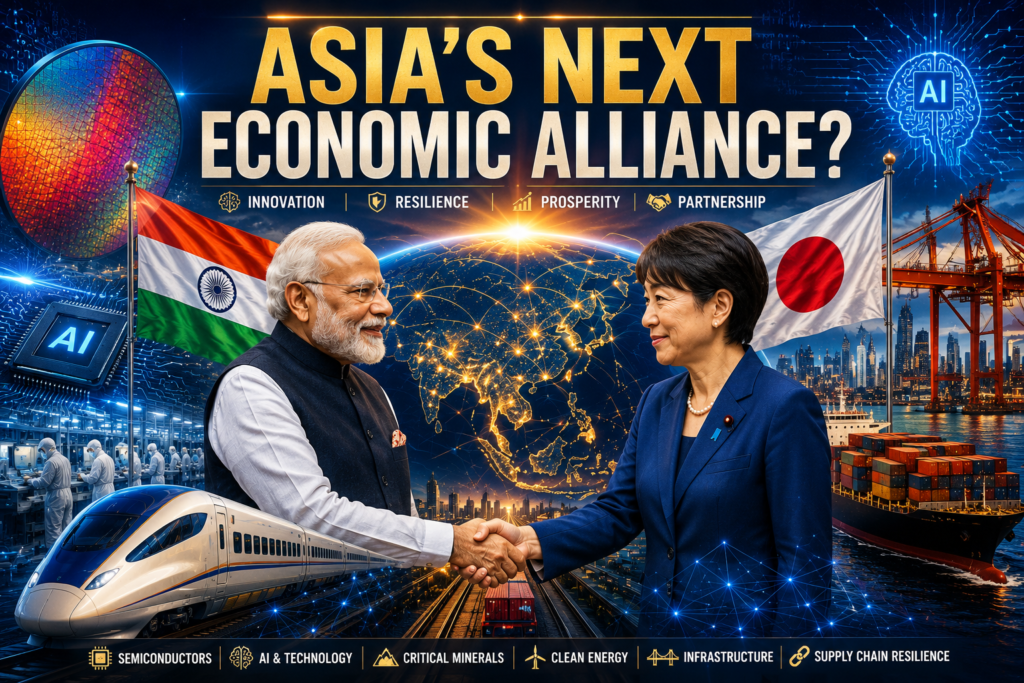
At first glance, the summit produced what many diplomatic meetings do—a long list of agreements covering artificial intelligence, semiconductors, clean energy, critical minerals, infrastructure, investment, defense cooperation, and supply-chain resilience.
Look more closely, though, and a different picture emerges.
None of these announcements is especially surprising on its own. The interesting part is how they connect. Together, they suggest that India and Japan are preparing for an economic landscape where trust, technological capability, and reliable industrial partnerships increasingly matter alongside market size and production costs.
That is a different way of thinking about globalization.
Rather than asking who can manufacture something most cheaply, governments are increasingly asking who can be relied upon when disruption inevitably arrives.
The summit makes more sense when viewed through that lens.
What Happened During the Summit?
India and Japan have worked together for decades. Japanese investment has helped finance industrial corridors, metro rail systems, logistics infrastructure, and the Mumbai-Ahmedabad high-speed rail project. The relationship has never lacked economic substance.
This summit, however, broadened its scope.
Instead of concentrating primarily on infrastructure and investment, both governments placed greater emphasis on industries expected to shape economic competitiveness over the next decade.
Artificial intelligence was one of the clearest examples.
The discussion wasn’t framed as a race to build the most powerful AI model. Instead, both countries emphasized collaboration between universities, research institutions, startups, and established technology companies. That approach may receive fewer headlines than announcing a new AI platform, but it’s closer to how innovation ecosystems actually develop. Breakthroughs rarely come from isolated companies; they usually emerge from networks of researchers, engineers, investors, and manufacturers working across multiple sectors.
Semiconductors formed another major pillar of the discussions.
Recent chip shortages revealed something policymakers had long understood but many businesses had overlooked: modern economies rely on a remarkably small number of production hubs for one of their most essential technologies.
The chips themselves are tiny. The industrial power attached to them is enormous.
Japan enters the partnership with decades of experience in semiconductor materials, manufacturing equipment, specialty chemicals, and precision engineering. India approaches the industry from a different direction, bringing strengths in chip design, software engineering, expanding manufacturing ambitions, and government-backed incentives aimed at developing a domestic semiconductor ecosystem.
Neither country can build a globally competitive supply chain alone.
Together, the partnership begins to look more substantial.
Critical minerals also featured prominently. Lithium, rare earth elements, graphite, and other strategic resources have become central to battery production, electric vehicles, renewable energy technologies, and advanced electronics. Governments increasingly compete not only for access to these materials but also for the industries that depend on them.
It’s a striking reversal from earlier phases of globalization.
For years, countries focused on moving manufacturing wherever costs were lowest. Today, many are paying closer attention to where the raw materials originate before manufacturing even begins.
Investment remained another major theme.
Japan is already among India’s largest development partners, and the summit reaffirmed commitments to infrastructure, industrial development, manufacturing, and emerging technology sectors. More importantly, discussions increasingly centered on private-sector participation rather than government funding alone. That’s often a better indicator of long-term confidence.
Defense cooperation and maritime security were also part of the agenda. On paper, they may appear separate from economic policy.
In reality, the distinction has become harder to maintain.
Secure shipping routes influence trade. Maritime stability affects energy imports. Reliable sea lanes determine how efficiently global supply chains function. Commercial resilience increasingly depends on strategic stability.
Viewed individually, the summit’s announcements may appear incremental.
Viewed together, they suggest the relationship is entering a different phase—one focused less on building roads and railways, and more on building the industrial ecosystem that sits behind future economic growth.
Why Is Japan Strengthening Its Partnership with India Now?
Timing is rarely accidental in international economics.
Japan’s growing emphasis on India reflects changes that have been unfolding across global markets for several years rather than a sudden diplomatic shift.
China remains one of the world’s most important manufacturing centers, and that isn’t likely to change anytime soon. Its industrial scale, supplier networks, and infrastructure remain difficult to replicate.
But companies are making different calculations than they were a decade ago.
Slower economic growth, rising labor costs, demographic pressures, geopolitical tensions, and export restrictions have encouraged multinational firms to spread production across multiple countries instead of concentrating it in one location.
This isn’t a story about leaving China.
It’s a story about reducing dependency.
That distinction explains why companies such as Apple have steadily expanded manufacturing in India while continuing significant operations elsewhere. Foxconn has increased investments in Indian facilities without abandoning its existing production network. Similar thinking is visible across electronics, automotive manufacturing, pharmaceuticals, and industrial equipment.
Businesses are paying for resilience in ways they rarely did before.
For years, resilience was treated as an insurance policy—important, but difficult to justify on a balance sheet. Recent disruptions changed that calculation. A factory that remains operational during a crisis can be worth more than a cheaper one that cannot.
That’s one reason the concept of “friend-shoring” has gained momentum.
The phrase is often presented as a geopolitical slogan, but companies tend to approach it more pragmatically. They’re looking for countries that offer political stability, improving infrastructure, skilled labor, predictable regulation, and governments willing to support long-term industrial investment.
India increasingly checks many of those boxes.
Its domestic market continues to expand, giving manufacturers access not only to export opportunities but also to growing local demand. The country produces large numbers of engineers each year, has invested heavily in digital infrastructure, and continues to encourage manufacturing through industrial incentives and policy reforms.
None of that guarantees success.
Execution will determine whether India captures a larger share of global manufacturing over the next decade. Investors know that. Governments know it too.
There’s another reason Japan finds India attractive, although it receives less attention.
Unlike new economic partners trying to build trust from scratch, India and Japan have spent decades working together. Infrastructure financing, industrial investment, technology cooperation, and institutional relationships already exist. That history reduces uncertainty, and in large-scale manufacturing, reducing uncertainty can be almost as valuable as reducing costs.
The broader point is easy to miss because it unfolds gradually rather than dramatically.
Globalization isn’t ending. It is becoming more selective.
And partnerships built over decades are suddenly worth much more than they were when efficiency was the only metric that mattered.
How This Partnership Could Reshape Asia’s Economy
Diplomatic summits rarely change the global economy on their own.
What they can do is reveal where governments believe the economy is heading. In this case, the signals are difficult to ignore. India and Japan are investing in sectors that sit at the center of the next industrial cycle rather than the last one.
Manufacturing May Become Less Concentrated—Not Less Global
Predictions that manufacturing will simply move from China to India miss what’s actually happening.
Most multinational companies aren’t replacing one manufacturing hub with another. They’re redesigning supply chains so they no longer depend so heavily on a single geography. A smartphone assembled in India may still rely on Japanese materials, Taiwanese chips, Korean components, and machinery built elsewhere. Modern manufacturing has become too interconnected for simple replacements.
The goal is optionality.
Executives increasingly ask a different question than they did ten years ago: What happens if one link in this chain stops working? That question now influences investment decisions as much as labor costs or tax incentives.
For India, this creates an opening rather than a guarantee.
Japanese investment, technical expertise, and long-term industrial partnerships could help expand manufacturing in electronics, automotive components, pharmaceuticals, industrial machinery, and precision engineering. Success won’t depend on one flagship factory. It will depend on whether suppliers, logistics firms, skilled workers, and supporting industries grow around those investments.
That’s how manufacturing ecosystems take shape.
The Semiconductor Story Is Bigger Than Chip Factories
Whenever countries announce semiconductor ambitions, attention usually turns to fabrication plants. They are expensive, politically visible, and easy to photograph.
Yet fabrication is only one piece of the industry.
The real competitive advantage often lies in everything surrounding the factory—advanced materials, manufacturing equipment, testing, packaging, software design, precision chemicals, maintenance, research, and highly specialized engineering talent.
Japan has spent decades building strengths across much of that ecosystem. In several areas, companies from Japan remain indispensable suppliers to chipmakers around the world despite producing relatively few finished semiconductors themselves.
India’s strengths are different.
Its semiconductor design talent is already deeply integrated into global technology companies, and government incentives are encouraging investments in fabrication, packaging, and electronics manufacturing. The challenge is connecting those capabilities into an industrial ecosystem that can sustain itself.
That’s the harder task.
It also explains why partnerships matter. No country—not even the largest economies—controls every part of the semiconductor value chain anymore. The industry has become too specialized for complete self-sufficiency.
Ironically, the more strategic semiconductors become, the less any single country can produce them entirely on its own.
Critical Minerals: The Competition Before Manufacturing Begins
Industrial competition increasingly starts long before products reach a factory.
Electric vehicles, batteries, wind turbines, advanced electronics, and defense technologies all rely on minerals that have become strategically important. Securing reliable access to lithium, rare earth elements, graphite, and other critical resources has become a priority for governments across Asia, Europe, and North America.
The race isn’t simply about owning mines.
Processing capacity, refining technology, transport infrastructure, environmental standards, and long-term supply agreements often determine who captures the greatest economic value.
India and Japan appear to recognize that distinction. Their cooperation extends beyond access to raw materials toward building supply chains capable of supporting battery manufacturing and advanced industries over the long term.
The conversation has quietly shifted.
A decade ago, energy security largely meant oil and natural gas. Increasingly, it also means ensuring that tomorrow’s batteries, electric motors, and renewable technologies have dependable sources of critical inputs.
Artificial Intelligence Is Becoming Industrial Infrastructure
Artificial intelligence is often discussed as though it’s primarily a software industry.
That view is becoming outdated.
Across manufacturing, logistics, healthcare, transportation, and scientific research, AI is increasingly functioning as infrastructure. Companies aren’t simply buying AI products; they’re redesigning production processes, improving quality control, reducing energy consumption, and automating complex tasks.
Factory floors may ultimately benefit as much as technology companies.
Japan contributes decades of expertise in robotics, automation, and precision manufacturing. India brings software development, digital services, engineering talent, and one of the world’s fastest-growing technology ecosystems.
Those capabilities are complementary in ways that aren’t always obvious.
One builds physical systems exceptionally well. The other excels at building digital ones. Increasingly, modern industry requires both.
The countries that combine hardware, software, and skilled talent effectively will likely gain advantages that extend well beyond the technology sector itself.
Clean Energy Is Also Industrial Policy
Climate policy and industrial policy are becoming harder to separate.
Governments certainly want to reduce emissions, but they also want to build industries capable of competing in markets that are expected to expand for decades. Hydrogen technologies, advanced batteries, renewable energy equipment, energy storage, and efficient manufacturing all fit into that strategy.
India and Japan are investing accordingly.
For businesses, the opportunity isn’t limited to energy companies. Manufacturers, engineering firms, equipment suppliers, financial institutions, and technology providers all stand to benefit if investment continues at scale.
The transition isn’t only about cleaner energy.
It’s also about who builds the industries behind it.
Infrastructure Still Determines Who Wins
Technology attracts attention.
Infrastructure determines whether technology can scale.
A semiconductor plant cannot operate efficiently without reliable electricity. Export-oriented manufacturers depend on ports that move goods predictably. Freight corridors reduce transport costs. Industrial clusters allow suppliers to locate close to customers, cutting both expenses and delays.
These are not glamorous investments.
They are often the difference between an ambitious industrial policy and a successful one.
Japan has spent years financing industrial corridors, metro systems, logistics projects, and high-speed rail in India. Those investments may prove even more valuable as manufacturing expands because infrastructure built years earlier often enables growth that arrives much later.
Industrial transformation tends to reward patience.
The Geopolitical Dimension
None of this exists outside geopolitics.
Trade, technology, investment, and security have become increasingly interconnected, particularly across the Indo-Pacific.
China is an unavoidable part of that discussion.
Both India and Japan continue to trade extensively with China, and neither country is pursuing economic isolation. At the same time, both have become more conscious of the risks that come with excessive concentration in critical industries.
Those two realities can exist together.
Businesses understand this better than political slogans sometimes suggest. Diversification is not the same as disengagement. Most companies are expanding options rather than abandoning existing relationships.
The Quad reflects a similar evolution.
Originally viewed largely through a security lens, it now carries a stronger economic dimension. Semiconductor cooperation, resilient supply chains, critical technologies, maritime connectivity, and digital standards have become regular parts of the conversation.
There’s a broader shift underneath all of this.
For much of the globalization era, governments generally assumed that economic integration would reduce strategic tensions. Today’s industrial policies suggest almost the opposite. Countries still want open trade, but they also want greater control over the technologies, infrastructure, and supply chains they consider essential.
Economic security has become a measurable policy objective rather than an abstract concept.
That has practical consequences.
Investors evaluate geopolitical risk more closely. Companies spend more on supply-chain resilience. Engineers increasingly find opportunities in industries governments now classify as strategic. Universities receive greater support for research tied to advanced manufacturing and critical technologies.
The effects are already filtering through business decisions long before they become obvious in trade statistics.
The larger story, then, isn’t simply that India and Japan are strengthening their partnership.
It’s that the rules shaping global industrial competition are changing—and both countries appear determined to adapt before those changes fully unfold.
What Does This Mean for Businesses Around the World?
The implications extend well beyond New Delhi and Tokyo.
For manufacturers, the biggest change isn’t that another production destination is emerging. It’s that supply-chain strategy has become more flexible. Companies now want alternatives they can activate when disruptions occur, whether those disruptions come from geopolitics, natural disasters, trade restrictions, or simple bottlenecks.
That shift affects decisions that rarely make headlines.
A component supplier deciding where to build its next facility. A logistics company expanding warehouse capacity near an industrial corridor. An engineering firm choosing where to recruit talent. These choices, repeated thousands of times, gradually reshape global manufacturing far more than a single government announcement ever could.
Technology companies are watching another part of the equation.
A stronger semiconductor ecosystem creates opportunities that extend well beyond chip production. Equipment manufacturers, packaging specialists, testing companies, design firms, software developers, research laboratories, and universities all become part of the same network. When one segment expands, others often follow.
Investors have noticed this pattern before.
Taiwan’s semiconductor industry didn’t become globally significant because of one factory. It evolved over decades as suppliers, engineers, research institutions, financiers, and manufacturers reinforced one another. Industrial ecosystems rarely emerge overnight.
The same principle applies elsewhere.
As battery production expands, companies involved in mineral processing, recycling, specialty chemicals, and advanced materials could find new opportunities. Logistics firms may benefit from shifting trade routes. Financial institutions will likely play a larger role in funding infrastructure and manufacturing projects that require patient capital rather than quick returns.
For businesses, resilience is becoming something that can be measured—and priced.
Keeping a second supplier or maintaining production across multiple countries may increase costs in the short term. Increasingly, companies see those costs as an investment rather than an inefficiency.
That is a notable change from the globalization model that dominated the early 2000s.
What Does It Mean for India?
For India, the opportunity extends beyond attracting foreign investment.
The larger challenge is moving further up the value chain.
Manufacturing creates jobs, but the greatest long-term gains usually come from designing products, developing technologies, building specialized suppliers, and creating industries capable of competing globally. Countries that master those stages tend to capture more value than those focused solely on assembly.
That is why technology transfer matters.
When engineers work alongside experienced manufacturing firms, when universities collaborate with industry, and when domestic suppliers begin meeting global standards, industrial capability grows in ways that are difficult to measure in a single year but become obvious over a decade.
There is also a demographic dimension.
India’s relatively young workforce gives it an advantage many advanced economies no longer have. But demographics alone are not an economic strategy. Skills, technical education, research capacity, and consistent policy matter just as much.
Infrastructure remains part of the story as well.
A freight corridor shortens delivery times. A modern port lowers export costs. Reliable electricity reduces production delays. Efficient customs procedures make manufacturers more competitive without changing the products they build.
These improvements often sound mundane compared with announcements about artificial intelligence or semiconductors.
In practice, they determine whether those industries flourish.
Challenges That Could Slow Progress
There is a temptation to treat major summits as turning points.
History suggests caution.
Many ambitious economic agreements lose momentum once the attention shifts elsewhere. Industrial policy is measured less by announcements than by projects completed, factories operating, research partnerships sustained, and private investment that continues long after political leaders leave the stage.
India faces familiar challenges.
Large infrastructure projects can be delayed by regulatory approvals, financing, land acquisition, or administrative complexity. Manufacturers continue comparing India with countries such as Vietnam, Indonesia, and Malaysia, all of which are competing aggressively for the same investment.
Global conditions add another layer of uncertainty.
A prolonged economic slowdown could make companies more cautious about expanding production. Financial markets, consumer demand, energy prices, and interest rates all influence investment decisions that governments cannot fully control.
There is another uncertainty worth acknowledging.
Some analysts argue that the current wave of industrial policy could eventually lead to a more fragmented global economy, with countries building parallel supply chains instead of integrated ones. Others believe diversification will make globalization more resilient rather than less efficient.
The outcome is still unfolding.
Perhaps that is why implementation matters more than ambition.
Is This the Beginning of a New Asian Economic Partnership?
The summit is unlikely to be remembered because of any single agreement.
Its significance lies elsewhere.
For years, the defining question of globalization was straightforward: Where can production be carried out most efficiently?
A different question is beginning to replace it.
Who can be relied upon when conditions become less predictable?
That change helps explain why discussions about semiconductors now include national security, why infrastructure projects are increasingly viewed as strategic investments, and why partnerships built over decades suddenly carry greater economic value.
India and Japan are responding to that reality rather than creating it.
Whether every commitment announced during the visit translates into measurable results remains uncertain. Some projects will move faster than expected. Others will encounter delays, funding constraints, or changing political priorities. That is typical of industrial transformation.
The broader direction, however, appears much clearer than it did a decade ago.
Globalization is not ending, nor is Asia dividing into isolated economic blocs. What is emerging instead is a more selective form of integration—one where countries still trade extensively, but place greater value on trusted relationships, technological capability, and resilient supply chains.
In that sense, the summit is less a story about India or Japan alone.
It is a window into how the next phase of globalization is likely to work.
The countries that shape it may not simply be those with the largest economies or the lowest costs. They may be the ones capable of combining innovation, industrial depth, reliable institutions, and long-term partnerships into something that can withstand an increasingly uncertain world.
That is the larger significance of this visit. Its importance isn’t confined to the agreements signed today, but to the economic model those agreements point toward.