
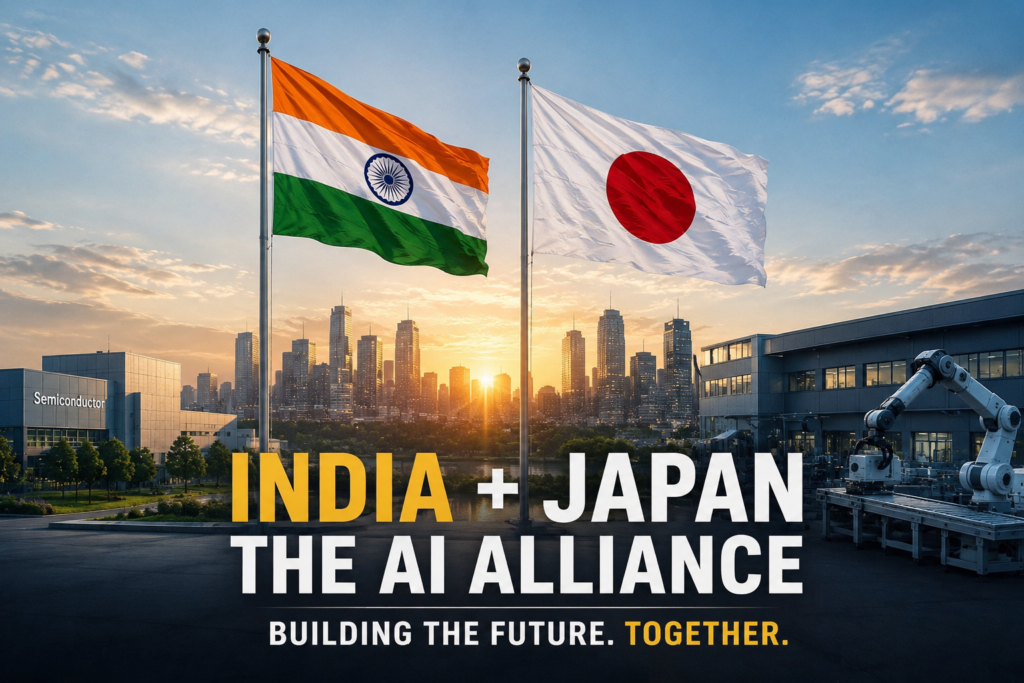
For the past few years, the global conversation around artificial intelligence has revolved around two familiar names.
The United States has dominated headlines with foundation models, multibillion-dollar investments, and an ecosystem led by companies such as OpenAI, Microsoft, Google, and NVIDIA. China has responded with its own strategy, combining state support, manufacturing strength, and rapidly growing domestic AI companies.
Viewed from a distance, it can seem as though the future of AI will be decided entirely by those two powers.
But that’s only part of the story.
A quieter shift has been unfolding across the Indo-Pacific. Rather than trying to outspend Washington or outscale Beijing, a number of countries are asking a different question: What if long-term competitiveness depends less on having every capability yourself and more on building trusted partnerships that combine different strengths?
That question surfaced repeatedly during the recent India-Japan summit.
Artificial intelligence was discussed alongside semiconductors, digital infrastructure, advanced manufacturing, research collaboration, and critical minerals. At first glance, those topics seem unrelated. Look a little closer and they begin to resemble pieces of the same industrial puzzle.
Perhaps that’s the biggest misconception surrounding AI today.
People often treat it as a software story because software is the part they can see. Chatbots write emails. AI generates images. Digital assistants answer questions.
The harder part to notice sits behind the screen.
Every AI model depends on vast computing clusters filled with advanced chips. Those chips require highly specialized manufacturing equipment, ultra-pure materials, precision engineering, stable electricity, secure supply chains, and thousands of skilled engineers. A single semiconductor fabrication plant can cost well over $20 billion before producing its first chip.
The models may grab the headlines. The factories make them possible.
That helps explain why governments increasingly discuss AI in the same meetings as manufacturing policy and national security.
Twenty years ago, countries competed to attract automobile factories. A decade later, much of the competition centered on smartphones, cloud computing, and internet platforms. Today, the strategic asset isn’t simply hardware or software. It’s the ability to build an ecosystem where advanced technologies can continuously evolve.
The language coming out of the India-Japan summit reflected that broader shift.
Neither country suggested it could replicate the American or Chinese AI ecosystem overnight. Instead, both emphasized long-term cooperation across industries that already complement one another. It is a slower strategy, perhaps a less glamorous one, but industrial history suggests these partnerships often matter more than a single breakthrough announcement.
The internet wasn’t built by one company. Modern semiconductor supply chains weren’t built by one country.
AI is unlikely to be either.
The Summit That Put AI at the Center
India and Japan have spent years strengthening ties through infrastructure projects, trade, maritime security, and defense cooperation. Technology has always been part of the conversation, but this summit suggested it is becoming one of the relationship’s defining pillars rather than a supporting topic.
One announcement alone wouldn’t justify that conclusion.
The broader pattern does.
Alongside artificial intelligence, leaders highlighted cooperation in semiconductors, digital infrastructure, advanced manufacturing, research, critical minerals, and workforce development. These priorities also mirror national strategies that both governments have been pursuing independently over the past several years.
There’s another way to look at that list.
Imagine trying to build an advanced AI industry without reliable chip supplies. Or attempting to manufacture semiconductors without precision machinery, highly trained engineers, stable electricity, specialized chemicals, or research institutions capable of producing the next generation of talent.
The chain quickly breaks.
That is why governments increasingly talk about “technology ecosystems” rather than individual industries. AI development now depends on decisions made far outside the software sector.
One overlooked detail is how similar this thinking has become across major economies.
The United States has expanded domestic semiconductor investment through the CHIPS and Science Act. Japan has committed billions of dollars to revive advanced chip manufacturing, including support for projects involving companies such as Rapidus and partnerships with global semiconductor firms. India, meanwhile, has launched semiconductor incentive programs designed to attract fabrication, packaging, and electronics manufacturing.
Different policies. Similar conclusion.
Industrial capability has returned to the center of technology strategy.
Against that backdrop, cooperation between India and Japan looks less like a diplomatic gesture and more like an attempt to connect complementary pieces of a much larger supply chain.
Why AI Has Become a Geopolitical Issue
Not very long ago, artificial intelligence occupied a fairly narrow space in the economy.
Retailers used it to recommend products. Streaming platforms suggested movies. Banks experimented with fraud detection. Most people encountered AI without giving it much thought.
That changed surprisingly quickly.
Today, the same governments that once viewed AI primarily as a commercial technology are investing in supercomputers, advanced chips, national AI missions, secure cloud infrastructure, and domestic research capacity. Finance ministries, defense departments, industrial planners, and technology agencies increasingly find themselves discussing the same subject from different perspectives.
Ironically, globalization created many of the technology dependencies that governments are now trying to reduce.
The world’s most advanced semiconductor supply chain stretches across multiple continents. Design software may come from one country, manufacturing equipment from another, specialty chemicals from a third, wafer fabrication from a fourth, and final assembly from somewhere else entirely. It is remarkably efficient when everything functions normally.
It is also remarkably fragile.
The chip shortages that followed the pandemic offered a glimpse of that vulnerability. Automobile production slowed. Consumer electronics were delayed. Manufacturers struggled to secure components that, in many cases, cost only a few dollars but were impossible to replace.
That experience changed political thinking.
Artificial intelligence relies on many of those same supply chains. So do robotics, quantum computing, autonomous systems, and advanced defense technologies.
Suddenly, semiconductor policy was no longer just industrial policy.
It had become economic policy, security policy, and increasingly, foreign policy.
That’s one reason AI is often compared with oil. Both underpin economic activity and strategic influence.
The comparison is useful—but only up to a point.
Oil powered the industrial age.
Artificial intelligence is beginning to shape the productive capacity of the knowledge economy. The countries that build the infrastructure behind it may ultimately influence far more than the software running on top.
Why India and Japan Need Each Other
Technology partnerships often sound impressive on paper. Many never move beyond memorandums of understanding.
This one is different because it starts with a practical reality rather than an ambitious promise.
India and Japan don’t bring the same strengths to the table—and that’s precisely the point.
India’s advantage is difficult to replicate. It has one of the world’s largest pools of software engineers, a fast-growing startup ecosystem, and digital public infrastructure that has expanded at extraordinary speed. Platforms such as Aadhaar, UPI, and DigiLocker have shown that digital systems can operate at a scale few countries have attempted. For AI developers, that creates an environment where new applications can move from pilot projects to millions of users remarkably quickly.
Scale, however, solves only part of the puzzle.
Training AI models is one challenge. Building the physical systems that support them is another.
Japan has spent decades mastering that side of the equation.
Long before generative AI became a global obsession, Japanese companies were refining industrial robots, precision machinery, semiconductor materials, and factory automation. Many of those firms rarely dominate technology headlines, yet their equipment quietly sits inside production lines around the world.
Walk through a modern semiconductor facility and that expertise becomes easier to appreciate. Wafer-handling robots move with microscopic precision inside ultra-clean rooms. Air filtration systems remove particles invisible to the human eye. Manufacturing tools operate within tolerances measured in nanometers.
It’s meticulous work. And it’s an environment where Japan has accumulated decades of experience.
The contrast between the two countries is striking.
India has spent years building digital platforms that connect hundreds of millions of people. Japan has spent years perfecting the industrial systems that manufacture some of the world’s most sophisticated technologies.
Different capabilities. Shared interests.
Neither country is without challenges.
India is still working to expand its advanced manufacturing base and semiconductor production. Japan faces an aging population, labor shortages, and slower domestic growth than many of its Asian neighbors.
There’s another way to look at those challenges.
Japan’s demographic pressures have accelerated investment in automation because businesses have little choice. India, with one of the world’s youngest workforces, is focused on creating higher-value jobs and moving beyond software services into advanced manufacturing.
The objectives are different.
The direction isn’t.
Rather than solving identical problems, each country brings capabilities the other increasingly needs. Partnerships built on complementary strengths often last longer than those built on convenience alone.
The China Factor—Without Reducing Everything to China
It’s difficult to discuss technology strategy in Asia without mentioning China.
It’s equally difficult to explain every regional partnership as a response to China.
Beijing remains one of the world’s leading technology powers. Its manufacturing ecosystem is unmatched in many sectors, its domestic AI market continues to expand, and Chinese companies remain deeply integrated into global electronics supply chains.
That hasn’t changed.
What has changed is how governments think about concentration risk.
The pandemic exposed vulnerabilities that had been building quietly for years. Factory shutdowns delayed everything from automobiles to consumer electronics. Shipping bottlenecks disrupted production schedules across continents. Export controls added another layer of uncertainty.
For many executives, resilience suddenly appeared on quarterly earnings calls alongside efficiency and cost reduction.
The shift has been subtle but significant.
For nearly three decades, globalization rewarded companies that concentrated production wherever it was cheapest or fastest. Today’s environment encourages something different: diversification, even if it costs more.
That comes with trade-offs.
Building alternative supply chains takes time. It requires duplicate facilities, additional investment, and more complex logistics. In purely financial terms, resilience is rarely the cheapest option.
It may, however, prove to be the less expensive option when disruption arrives.
India and Japan’s cooperation fits into that broader trend.
The goal is not to replace China’s role in global technology manufacturing. That would be unrealistic. The objective is to create additional pathways—for semiconductors, digital infrastructure, advanced manufacturing, and critical technologies—so that governments and businesses have more strategic flexibility.
It’s a quieter ambition than technological supremacy.
It may also be the more achievable one.
Why Semiconductors Matter More Than the AI Headlines
Every major AI breakthrough begins with software.
Almost every commercial AI breakthrough depends on hardware.
That distinction is easy to miss because software captures public attention while manufacturing remains largely invisible.
Training a large AI model requires thousands of advanced processors operating inside hyperscale data centers. Those processors begin life inside semiconductor fabrication plants where silicon wafers pass through hundreds of manufacturing steps before becoming finished chips.
The process can take months.
The factories themselves take years to build.
Perhaps the biggest misconception in today’s AI conversation is that whoever develops the smartest model automatically wins.
The reality is more complicated.
Without advanced chips, there are no frontier AI models.
Without semiconductor materials, there are no advanced chips.
Without lithography systems, precision manufacturing equipment, specialty chemicals, and highly reliable supply chains, there are no semiconductor factories.
Each layer depends on another.
That’s one reason countries are investing billions of dollars in semiconductor production. It’s also why Japan’s role deserves more attention than it sometimes receives.
Japanese firms are global leaders in several areas that rarely make headlines, including semiconductor materials, silicon wafers, photoresists, manufacturing chemicals, and precision production equipment. Many AI companies never interact directly with those businesses, yet their products are essential long before an AI model reaches a data center.
India approaches the sector from a different starting point.
Its semiconductor industry is still developing, supported by government incentives, international partnerships, and new manufacturing projects. Progress will take time. Semiconductor ecosystems are built over decades, not election cycles.
History offers a useful reminder.
Taiwan didn’t become a semiconductor powerhouse overnight. South Korea’s electronics industry wasn’t created in a few years. Japan’s manufacturing reputation was built through sustained investment that stretched across generations.
Industrial capability compounds slowly.
Then, almost suddenly, it begins to look inevitable.
The same may prove true for AI infrastructure.
The Economic Impact Could Extend Far Beyond Technology
Technology partnerships are often announced with ambitious language.
Their real significance usually becomes visible years later—in industrial parks, research labs, university campuses, and factory towns rather than summit halls.
If the India-Japan partnership develops as both governments hope, the effects are unlikely to be confined to AI companies alone.
Consider what happens when a new semiconductor manufacturing facility is built.
The headlines focus on the investment, but the economic activity spreads much further. Construction companies win contracts. Universities expand engineering programs. Suppliers establish regional operations. Logistics firms, equipment manufacturers, utilities, and local businesses all become part of the ecosystem.
One factory rarely stays just one factory.
The same pattern has played out in places as different as Taiwan’s Hsinchu Science Park, South Korea’s semiconductor clusters, and parts of the United States that are now attracting chip investments through the CHIPS and Science Act.
Industrial ecosystems have a habit of reinforcing themselves.
That’s where partnerships begin to matter.
Japan’s investment capacity and manufacturing expertise could help accelerate projects that India has already identified as strategic priorities. India, in turn, offers something increasingly valuable to global companies: a large domestic market, a deep technology workforce, and an economy expected to remain among the fastest-growing major economies over the coming years.
The opportunities extend beyond manufacturing.
Joint research programs can produce new intellectual property. Universities can exchange talent. Startups gain access to larger pools of capital and experienced industrial partners. Engineers move between countries. Over time, those relationships often become as valuable as the original investment itself.
There is another, less visible effect.
When global companies decide where to invest billions of dollars, they are not simply comparing tax incentives. They assess political stability, long-term policy direction, infrastructure, workforce quality, and the strength of local partnerships.
Confidence is difficult to measure.
It is also surprisingly powerful.
What It Means for the Global AI Race
Much of the public conversation still treats the AI race as a competition between the United States and China.
That framing is understandable. It is also becoming less complete.
The AI economy is far larger than the companies building frontier language models.
Someone designs the chips.
Someone manufactures them.
Someone supplies the ultra-pure chemicals, industrial gases, silicon wafers, precision optics, and manufacturing equipment. Someone builds the data centers. Someone develops enterprise software that allows traditional industries to use AI in practical ways.
Leadership exists at every layer.
One overlooked detail is that countries do not need to dominate every part of this chain to become strategically important.
The Netherlands, for example, occupies an outsized position in the semiconductor industry through ASML’s lithography systems. Taiwan’s influence rests heavily on manufacturing. South Korea combines advanced memory chips with consumer electronics. Japan remains indispensable in several categories of semiconductor materials and production equipment.
Each occupies a different position.
Each shapes the industry.
India and Japan appear to be moving toward a similar model—one built less on competing with every global AI leader and more on strengthening the parts of the ecosystem where their capabilities naturally reinforce each other.
It’s a quieter strategy.
History suggests quiet strategies are often underestimated.
Why This Matters Beyond India and Japan
The ripple effects of this partnership are unlikely to stop at two countries.
Across Southeast Asia, governments are pursuing many of the same goals: attracting advanced manufacturing, strengthening digital infrastructure, expanding semiconductor capabilities, and preparing their workforces for increasingly AI-driven industries.
Several ASEAN economies are positioning themselves as alternative manufacturing hubs as companies diversify production networks. Australia continues investing in critical minerals that feed advanced technology supply chains. South Korea remains central to memory chip production and advanced electronics.
The map of technological cooperation is becoming more interconnected.
The Quad adds another layer.
Although often discussed through the lens of regional security, cooperation among India, Japan, the United States, and Australia increasingly extends into critical technologies, supply-chain resilience, cybersecurity, and emerging industries. Not every initiative will produce immediate commercial results, but they create frameworks that businesses often build upon later.
Investors have noticed the shift.
Capital increasingly follows ecosystems rather than individual companies. Venture funds, institutional investors, and multinational manufacturers are looking for places where research, skilled workers, industrial capacity, and government policy reinforce one another.
That changes how countries compete.
The question is no longer simply who has the biggest technology companies.
Increasingly, it is who can create the most durable environment for innovation.
Opportunities Alone Will Not Guarantee Success
None of this should be mistaken for inevitability.
Technology partnerships are easier to announce than to execute.
Building a competitive AI ecosystem demands sustained investment over many years. Semiconductor manufacturing requires extraordinary amounts of capital, reliable infrastructure, specialized suppliers, and technical expertise that cannot be assembled overnight.
Money alone doesn’t solve those problems.
Neither does political ambition.
Talent may become the most difficult constraint of all. Around the world, governments and companies are competing for AI researchers, semiconductor engineers, materials scientists, and advanced manufacturing specialists. Developing that workforce takes far longer than constructing a factory.
Policy presents another balancing act.
Countries want to encourage innovation while protecting data, intellectual property, and national security. Regulations that are too restrictive risk slowing investment. Rules that are too loose create different vulnerabilities.
There is productive tension here.
Resilience has become a strategic priority, but resilience is rarely inexpensive. Diversified supply chains improve security while increasing costs. Domestic manufacturing strengthens long-term capabilities but often raises short-term expenses.
Governments are increasingly choosing resilience anyway.
Whether that proves to be the right trade-off will become clearer over the next decade rather than the next quarter.
For India and Japan, the harder work begins after the summit communiqués are forgotten.
The Bigger Picture
Every era has its defining infrastructure.
In the late 19th century, it was railways that reshaped economies by connecting markets that had once been isolated. Much of the 20th century revolved around electricity, highways, and later the internet. Countries that invested early rarely benefited only from the infrastructure itself. Entire industries grew around it.
Artificial intelligence is beginning to follow a similar path.
It is easy to think of AI as a collection of impressive tools—a chatbot that answers questions, software that writes code, or an application that generates images in seconds. Those breakthroughs are visible because they sit in front of users.
The transformation happening underneath is slower and far less visible.
Across the world, governments are funding supercomputers, expanding data-center capacity, supporting semiconductor manufacturing, modernizing power grids, investing in research universities, and rewriting industrial strategies. Much of this work attracts little public attention because it doesn’t produce a product people can download.
Yet this is where long-term competitiveness is likely to be decided.
History offers an interesting pattern.
Countries that shaped earlier industrial revolutions were not always those that invented every breakthrough. More often, they built the ecosystems that allowed those breakthroughs to spread at scale. The United States became an industrial leader not simply because of innovation, but because it combined research, capital, manufacturing, infrastructure, and a vast domestic market. Post-war Japan followed a different route, turning precision manufacturing and relentless industrial improvement into global competitive advantages.
The lesson isn’t that history repeats itself.
It’s that technological leadership has rarely depended on one capability alone.
That makes the India-Japan partnership worth watching.
India contributes scale, software talent, entrepreneurial energy, and one of the world’s fastest-growing digital economies. Japan brings decades of industrial expertise, advanced manufacturing, precision engineering, and experience building technologies that operate reliably over decades rather than product cycles.
Neither side has everything.
Together, they cover far more ground than either could on its own.
Perhaps that’s the broader shift taking place in global technology.
For much of the digital era, success was often measured by the strength of individual companies. Today, competition increasingly revolves around ecosystems—networks of researchers, manufacturers, investors, universities, governments, and supply chains that reinforce one another over time.
That changes the nature of the AI race.
Winning may not mean producing the most advanced model every year. It may depend on something less visible: who can consistently design better chips, train more engineers, finance ambitious research, secure reliable supply chains, and turn scientific advances into industrial capability.
Those advantages accumulate quietly.
Then, over time, they become difficult to challenge.
There is still plenty of uncertainty.
Artificial intelligence is evolving faster than most governments can regulate it. New breakthroughs could reshape today’s competitive landscape. Political priorities may change. Economic slowdowns could delay investment. Even strong partnerships sometimes struggle once they move from summit declarations to implementation.
None of that diminishes the significance of what India and Japan are attempting.
If anything, it places greater emphasis on execution.
The recent summit did not settle the global AI race, nor did it redraw the technology map overnight. It did, however, highlight a different way of thinking about competition—one based less on technological self-sufficiency and more on trusted collaboration between countries with complementary strengths.
Whether that approach becomes a defining feature of the next industrial era remains an open question.
The more interesting question may be whether future leadership in artificial intelligence belongs to the countries building the smartest algorithms—or to those patiently building the ecosystems that make those algorithms possible.