Only a few years ago, governments were consumed by very different priorities. The immediate task was rebuilding economies after the pandemic, taming inflation, supporting businesses, and repairing stretched public finances. Defense spending remained part of national budgets, but it rarely dominated political debate or economic planning.
That now feels like a different era.
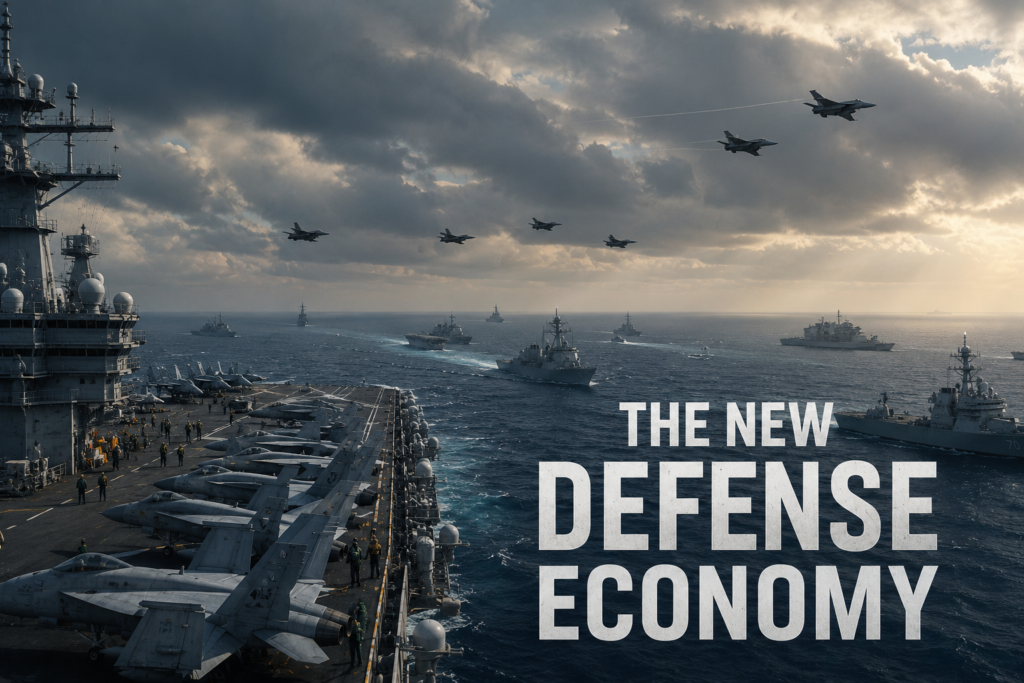
Across Europe, Asia, the Middle East, and North America, governments are committing to military budgets that would have been difficult to imagine only a few years ago. Long-term modernization plans are replacing short-term procurement decisions. Ammunition factories are expanding production. Shipyards are receiving new orders. Defense partnerships are deepening, while technologies once considered experimental are steadily becoming part of mainstream military planning.
The scale of the spending naturally attracts attention. What’s more revealing, though, is how broadly this shift is unfolding.
Countries facing very different political realities, economic pressures, and security challenges are arriving at remarkably similar conclusions. That kind of convergence is unusual. Democracies and authoritarian governments rarely agree on much, yet many are quietly reshaping national priorities in strikingly similar ways.
Which raises a bigger question.
Are today’s larger defense budgets simply another response to geopolitical instability? Or are they evidence that governments increasingly see security as something woven into economic policy, industrial planning, and technological competitiveness rather than treated as a separate policy area?
The answer isn’t obvious.
Military spending has always moved in cycles. The Cold War produced decades of sustained investment before many countries embraced the so-called “peace dividend” of the 1990s, reducing defense budgets as major interstate conflict appeared less likely. After the attacks of September 11, spending climbed again, although much of that increase focused on counterterrorism rather than preparing for competition between major powers.
Today’s environment doesn’t fit neatly into either period.
The concern extends beyond individual conflicts. Governments are increasingly asking whether the global system that supported decades of relatively predictable trade and security is becoming less dependable. If that assumption changes, defense planning changes with it.
And defense planning no longer ends with the military.
It reaches into semiconductor production, energy security, artificial intelligence, shipping networks, critical minerals, and manufacturing capacity. Increasingly, military budgets resemble one component of a much broader industrial strategy.
That may turn out to be the more important story.
The Numbers Tell an Unusual Story
Global military expenditure has reached record levels in recent years, but the headline figure only tells part of the story.
History has seen large military buildups before. What feels different this time is how widespread they have become.
European governments are expanding defense commitments. Several Asian nations are accelerating modernization programs. Middle Eastern countries continue investing heavily in advanced capabilities, while North America remains both a major military spender and a key supplier to allies.
These governments are not operating under similar economic conditions. Some face slow growth. Others are wrestling with aging populations, persistent inflation, or rising public debt. Under ordinary fiscal circumstances, many of these countries would be under pressure to limit spending rather than expand it.
Yet defense has continued moving higher on the political agenda.
That shift says as much about changing perceptions of risk as it does about military planning itself.
Interestingly, many policymakers no longer describe defense spending as insurance against a single conflict. The discussion increasingly revolves around resilience—the ability to withstand prolonged disruption, whether that comes from war, cyberattacks, supply-chain failures, or economic coercion.
It’s a subtle change in language.
But it reflects a much larger change in thinking.
Why Governments Are Spending More
No single event explains the current surge in military spending.
Instead, several developments have gradually reinforced one another. Some exposed weaknesses that governments had underestimated. Others challenged assumptions that had shaped defense policy for decades.
Taken together, they are changing not only how countries think about security, but also how they think about industry, technology, and economic resilience.
The pattern becomes clearer when viewed through that wider lens.
Lessons From Recent Wars
Recent conflicts have done more than reshape battlefields. They have exposed assumptions that many governments had quietly built their defense policies around.
For years, military planners in several countries operated on the belief that future wars would likely be short, technologically precise, and supported by global supply chains that could quickly replenish equipment if necessary.
The war in Ukraine challenged much of that thinking.
One of its clearest lessons wasn’t about a single weapon system. It was about endurance. Ammunition stockpiles that once seemed adequate disappeared far more quickly than expected, forcing governments to confront an uncomfortable reality: sophisticated weapons matter little if they cannot be replaced fast enough.
The conversation shifted almost overnight.
Instead of asking how advanced a military was, policymakers began asking whether domestic industry could sustain it through months—or years—of conflict.
That is a very different question.
Behind every missile launched sits a factory. Behind every armored vehicle are suppliers producing steel, electronics, engines, and components that rarely make headlines. Modern warfare has made those industrial networks visible again.
In many ways, the quieter competition is no longer taking place on the battlefield. It is unfolding inside manufacturing plants, logistics hubs, and supply chains.
The conflicts in the Middle East reinforced a similar lesson from another direction.
Attacks on commercial shipping in the Red Sea did not simply threaten vessels moving through one waterway. They disrupted insurance markets, delayed cargo, increased freight costs, and reminded governments how quickly regional instability can ripple through global trade.
Security, in other words, is becoming harder to separate from economics.
Rising Tensions in Asia
The Indo-Pacific tells a different story, but it points toward the same conclusion.
China’s expanding military capabilities, tensions surrounding Taiwan, territorial disputes in the South China Sea, and North Korea’s continued missile development have prompted governments across the region to rethink long-term defense planning.
Perhaps the most striking example is Japan.
For decades, Japan maintained one of the world’s more restrained defense postures, shaped by the legacy of the Second World War and its postwar constitution. That restraint is gradually giving way to a broader reassessment of the country’s security environment.
Elsewhere across the region, military cooperation has become noticeably deeper. Joint exercises have expanded. Intelligence sharing has increased. Defense partnerships that once seemed largely symbolic are becoming operational.
What’s interesting is that few governments describe these moves as preparation for inevitable conflict.
They describe them as preparation for uncertainty.
That distinction matters because uncertainty rarely disappears with a single diplomatic breakthrough. It tends to influence planning for years.
NATO’s Changing Priorities
Europe has experienced one of the most significant shifts in defense policy since the end of the Cold War.
For much of the 1990s and early 2000s, many European countries reduced military spending while assuming that large-scale interstate conflict on the continent had become increasingly unlikely.
Those assumptions have been challenged.
Today, many NATO members are increasing defense budgets, modernizing aging equipment, strengthening logistics, expanding ammunition production, and upgrading the infrastructure needed to move personnel and equipment quickly across Europe.
Much of this investment attracts little public attention.
New rail links capable of transporting heavy armored vehicles. Expanded ammunition facilities. Maintenance depots. Warehouses. Fuel storage. Ports capable of handling larger military deployments.
None make dramatic headlines.
Collectively, however, they reveal something important. Governments appear less focused on responding to isolated crises and more concerned with rebuilding capabilities that can endure over decades.
That reflects a longer planning horizon than many countries had maintained for years.
New Types of Warfare
Defense spending itself is changing.
Traditional investments in tanks, fighter aircraft, submarines, and naval fleets remain essential, but they now represent only part of the picture.
Modern military competition increasingly extends into areas that rarely resembled defense policy a generation ago.
Cybersecurity is one example.
Major cyberattacks can disrupt financial systems, hospitals, power grids, transportation networks, and government operations without a single missile being fired. Protecting those systems has become a strategic priority rather than simply an IT responsibility.
Artificial intelligence is creating another shift.
Much of the discussion focuses on autonomous weapons, but AI’s broader impact may prove even more significant. Intelligence analysis, logistics planning, predictive maintenance, battlefield simulations, and command decisions are all becoming increasingly data-driven.
Software is quietly becoming as strategically valuable as hardware.
Space presents another example.
Satellites underpin navigation, communications, weather forecasting, surveillance, precision targeting, financial transactions, and missile warning systems. They support civilian economies every day while simultaneously serving military operations.
That dual role makes them unusually important—and unusually vulnerable.
Drone technology has followed a similar path. Relatively inexpensive unmanned systems are performing missions that once required aircraft costing tens or hundreds of millions of dollars. The economics of military capability are changing alongside the technology itself.
This helps explain why governments are investing simultaneously in artificial intelligence, semiconductor manufacturing, secure communications, electronic warfare, missile defense, and space infrastructure.
These are no longer separate conversations.
Modern defense increasingly resembles an ecosystem where software, manufacturing capacity, critical minerals, industrial resilience, and conventional military power reinforce one another.
Which brings us back to the broader shift discussed earlier.
Military budgets are no longer expanding in isolation. They are becoming increasingly intertwined with national industrial strategy, technological leadership, and economic security.
That may prove to be the defining characteristic of this era—not simply higher defense spending, but a much broader definition of what defense actually means.
Defense Spending Is No Longer Just About Defense
One of the biggest misconceptions about military budgets is that they benefit only armed forces.
That distinction is becoming harder to defend.
Increasingly, governments see defense investment as part of a much broader effort to strengthen industrial capacity, technological leadership, and economic resilience. The boundaries separating those priorities are beginning to blur.
Semiconductors offer one of the clearest examples.
Advanced chips power missile guidance systems and military communications, but they also sit inside smartphones, medical equipment, data centers, electric vehicles, and artificial intelligence infrastructure. A country that cannot secure reliable access to advanced semiconductors isn’t just facing a defense challenge. It’s confronting an economic one.
The same pattern appears elsewhere.
Rare earth elements and other critical minerals have become strategic resources because they underpin everything from precision-guided weapons to renewable energy technologies. Supply chains that once seemed driven purely by commercial efficiency are now being evaluated through the lens of national security.
What’s changing isn’t simply procurement.
It’s the definition of strategic infrastructure.
A decade ago, governments worried about military readiness. Today, they’re also asking whether they can manufacture key technologies domestically, secure essential raw materials, and keep critical industries operating during prolonged disruption.
Defense policy is gradually becoming part of the economic operating system rather than a standalone government function.
That shift reaches well beyond ministries of defense.
Which Industries Could Benefit?
The obvious beneficiaries remain defense contractors producing aircraft, armored vehicles, missiles, and naval systems.
But focusing only on those companies misses much of the story.
As governments rebuild industrial capacity, demand increasingly spreads across entire manufacturing ecosystems.
Shipyards are expanding production as naval modernization accelerates. Aerospace firms continue developing surveillance platforms, transport aircraft, and space-related technologies. Steel producers, advanced manufacturers, and precision engineering companies all become part of the supply chain.
Walk through a modern defense manufacturing facility and the picture is strikingly different from the traditional image of heavy industry. Alongside welders and assembly lines are software engineers, robotics specialists, data analysts, and cybersecurity teams. Modern defense manufacturing increasingly looks like advanced technology production with military applications.
Artificial intelligence companies are finding opportunities in predictive maintenance, logistics, intelligence analysis, and autonomous systems. Cybersecurity firms are becoming just as essential, particularly as governments harden digital infrastructure against increasingly sophisticated attacks.
Perhaps surprisingly, some of the most strategically valuable companies may never manufacture a weapon at all.
Semiconductor producers, satellite operators, logistics providers, cloud infrastructure firms, and mining companies supplying critical minerals increasingly occupy positions that governments now regard as strategically important.
Military competition is no longer defined solely by who builds the most advanced weapons.
Increasingly, it’s about who can sustain the industrial ecosystem behind them.
The Economic Trade-Off
None of this comes without cost.
Every expansion of public spending eventually raises the same question: where will the money come from?
Some governments can finance larger defense budgets through stronger economic growth. Others will rely on additional borrowing, spending cuts elsewhere, or higher tax revenues over time.
Each approach carries consequences.
Countries already managing large debt burdens face particularly difficult choices. Resources directed toward defense cannot simultaneously fund healthcare, education, transport infrastructure, or social welfare.
That tension isn’t new.
The difference today is that governments increasingly argue these priorities are less separate than they once appeared. Secure trade routes support economic activity. Domestic manufacturing creates skilled employment. Investments in research and advanced technologies often generate civilian benefits alongside military ones.
Critics remain unconvinced.
They argue sustained military expansion risks increasing debt while diverting resources from areas that may produce stronger long-term economic returns.
Neither perspective fully captures the complexity.
The real challenge isn’t choosing between defense and economic growth. It’s determining how much security is necessary to preserve the conditions that allow economic growth in the first place.
There isn’t a universally accepted answer.
Why This Matters Beyond the Military
For many people, defense policy feels distant from everyday life.
Its effects rarely are.
When governments place larger orders for military equipment, thousands of suppliers often benefit alongside the prime contractors. Technological breakthroughs originally funded for defense regularly find civilian uses years later. GPS remains the classic example, but history offers many others.
Geopolitical instability influences shipping costs, insurance premiums, energy markets, investment decisions, and inflation. Those changes eventually reach consumers, even if they never follow defense policy closely.
What’s easy to overlook is how interconnected these systems have become.
A disruption in one shipping corridor can affect factory production on another continent. A shortage of semiconductors can slow industries far removed from defense. A cyberattack on critical infrastructure can produce economic costs comparable to physical damage.
National security increasingly operates through economic networks rather than only across military front lines.
India’s Position in This Global Shift
India occupies a distinctive position within this changing landscape.
Its security environment demands continued military modernization, yet its long-term ambitions extend well beyond defense.
The country’s push to expand domestic manufacturing through initiatives such as Make in India reflects that broader objective. Reducing dependence on imported equipment while developing indigenous capabilities serves both strategic and economic goals.
India has also continued strengthening partnerships with multiple countries rather than relying exclusively on one bloc. That diplomatic flexibility has become an increasingly valuable asset as global competition intensifies.
Geography reinforces India’s importance.
The Indian Ocean carries a substantial share of global trade and energy flows. Securing those sea lanes is therefore not simply a military responsibility; it is central to economic stability across much of Asia.
For India, defense manufacturing represents more than procurement.
It represents an opportunity to strengthen advanced manufacturing, develop technological expertise, expand exports, and move further up global industrial value chains.
That opportunity, however, depends on sustained investment, efficient procurement, and continued innovation rather than budget increases alone.
Could This Become a Long-Term Trend?
History suggests caution before declaring the beginning of a permanent era.
Military spending has always reflected changing geopolitical realities. Periods of heightened tension are often followed by years of stabilization.
Yet several factors distinguish the current environment.
Strategic competition between major powers appears likely to persist. Artificial intelligence, cyber capabilities, autonomous systems, and space technologies continue evolving rapidly. Supply-chain resilience has become a political objective as well as an economic one.
Each reinforces the others.
That layered interaction makes today’s defense environment different from earlier spending cycles, where procurement often focused primarily on replacing military hardware.
This time, governments are simultaneously rebuilding industrial capacity, investing in technology, securing supply chains, and strengthening conventional military capabilities.
The agenda is broader.
Whether it proves permanent remains uncertain.
Risks of a Global Defense Boom
Greater investment can strengthen deterrence.
It can also create new risks.
History contains numerous examples of military buildups becoming self-reinforcing, with one country’s modernization encouraging another’s. Arms competition often develops gradually rather than through deliberate policy.
Technological change introduces additional uncertainty.
Artificial intelligence, cyber operations, autonomous systems, and the growing importance of space all create strategic questions that governments are still learning to manage. The rules remain less developed than the technologies themselves.
Perhaps the greatest danger isn’t technological.
It’s human.
Periods of geopolitical rivalry often become most dangerous not because leaders seek conflict, but because they misunderstand one another’s intentions.
Military preparedness can reduce certain risks.
Diplomacy remains indispensable for managing the rest.
A Strategic Shift That Reaches Beyond the Battlefield
The rise in global defense spending appears to reflect something larger than a temporary response to today’s conflicts.
Security is increasingly being treated as an economic question, an industrial question, a technological question, and only then as a military one. That shift quietly changes how governments allocate capital, how businesses invest, how supply chains evolve, and how countries measure national strength.
Perhaps that is the deeper transformation.
The world’s major powers are no longer competing only to build stronger armed forces. They are competing to build more resilient economies capable of sustaining those armed forces through prolonged uncertainty.
If that interpretation proves correct, today’s defense budgets may ultimately be remembered as only the visible part of a much broader strategic realignment.
The factories expanding production, the semiconductor plants under construction, the rare-earth projects receiving fresh investment, the satellites entering orbit, and the software being written for tomorrow’s autonomous systems may tell the larger story.
The question, then, isn’t simply whether the world is spending more on defense.
It’s whether we’re witnessing the emergence of a global economic model in which security becomes one of the central forces shaping investment, industry, and international competition for years to come.