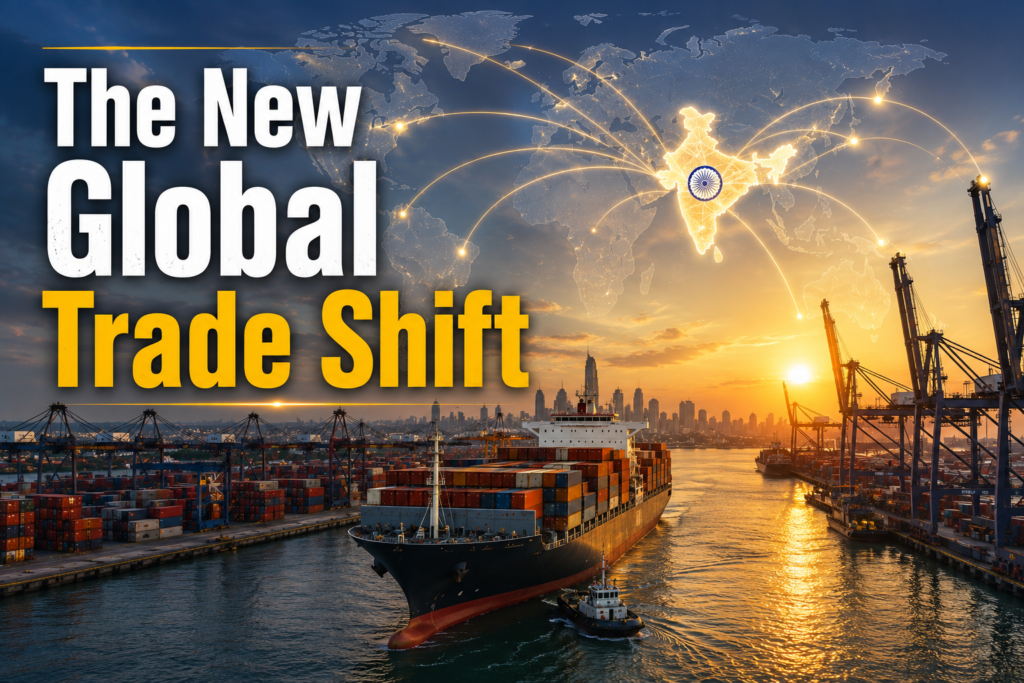
Global trade rarely changes overnight.
There are no opening ceremonies. No single agreement that redraws the map. Most of the time, the biggest shifts begin quietly—in corporate boardrooms, government ministries, shipping routes, and investment plans that attract little public attention until years later.
That is what appears to be happening today.
For much of the past three decades, businesses optimized supply chains around one objective: efficiency. Manufacturing moved wherever costs were lowest, inventories became leaner, and products crossed continents with remarkable speed. Globalization rewarded companies that could shave a few more dollars from production without slowing delivery.
That logic hasn’t disappeared. But it no longer stands alone.
Today, executives weigh a different set of questions before approving a new factory or expanding an existing one. How vulnerable is this supply chain to geopolitical tensions? What happens if export controls tighten? Can production continue if a critical shipping route is disrupted?
Cheap production is still valuable. Predictable production is becoming priceless.
This shift is changing where companies invest, how governments negotiate trade agreements, and which countries are emerging as the next generation of manufacturing hubs.
India is increasingly part of that conversation.
The opportunity, however, should not be mistaken for certainty. Global companies may be looking for alternatives, but they are not looking for just any alternative. They want markets that offer scale, policy stability, reliable infrastructure, and long-term confidence.
Whether India can meet those expectations may shape one of the country’s biggest economic opportunities since liberalization.
The Global Trading System Is Being Rewritten
Trade is no longer treated as a purely economic issue.
Governments increasingly see supply chains as strategic assets. In many industries, where something is manufactured has become almost as important as how efficiently it is produced.
That change didn’t happen because of one crisis. It happened because several different crises exposed the same weakness.
The pandemic revealed how quickly factory shutdowns in one region could disrupt production around the world. Russia’s invasion of Ukraine unsettled energy markets and commodity supplies. More recently, instability in parts of the Middle East reminded businesses that shipping routes—often taken for granted—can suddenly become sources of uncertainty.
Each event looked different on the surface.
Together, they forced companies to ask a more uncomfortable question: what happens when too much of the global economy depends on too few locations?
That question continues to reshape investment decisions.
The headlines naturally focus on tariffs, sanctions, or diplomatic disputes. The quieter transformation is happening inside boardrooms, where companies are redesigning supply chains they expect to rely on for the next twenty or thirty years.
Those decisions tend to outlast political cycles.
As a result, ideas such as friend-shoring, near-shoring, and de-risking have moved from policy discussions into corporate strategy. The terminology varies, but the objective is remarkably consistent: build supply chains that are resilient enough to absorb disruption without bringing production to a standstill.
Interestingly, many companies are no longer chasing the absolute lowest production cost. They are searching for the lowest level of risk they can reasonably achieve.
That changes the calculation.
Why Businesses Are Looking Beyond China
For years, asking manufacturers to reduce their dependence on China would have seemed unrealistic.
China remains one of the world’s most sophisticated manufacturing ecosystems. It offers scale, deep supplier networks, skilled labour, and infrastructure that few countries can replicate. None of that disappears because geopolitical tensions have increased.
Yet relying too heavily on any single country now looks less attractive than it once did.
Rising labour costs have gradually narrowed some of China’s traditional cost advantages. Trade disputes have created uncertainty over tariffs and market access. Restrictions on advanced technologies—particularly semiconductors and high-end manufacturing equipment—have added another layer of complexity for multinational companies.
Most businesses are not planning an exit.
They are buying insurance.
That idea has become known as the China Plus One strategy.
Rather than replacing China, companies are expanding manufacturing capacity elsewhere while maintaining a significant presence inside the Chinese market. Diversification has become a business decision rather than a political statement.
The shift is already visible.
Apple has expanded iPhone assembly in India while continuing large-scale manufacturing in China. Electronics suppliers are investing across Southeast Asia. Automotive manufacturers are spreading production across multiple countries instead of concentrating future capacity in one location.
The more interesting question is no longer whether China remains essential.
It does.
The question is where the next factory gets built.
Increasingly, that answer is different from what it would have been ten years ago.
Why India Is Becoming One of the Biggest Alternatives
This is where India’s position begins to look more compelling.
Unlike many emerging manufacturing destinations, India offers companies two opportunities at once. It is a place to produce for global markets, but it is also becoming one of the world’s largest consumer markets. That combination is relatively rare.
A factory built in India does not have to depend entirely on exports. Over time, it can also serve hundreds of millions of domestic consumers whose purchasing power continues to expand.
That changes investment decisions in subtle ways. A slowdown in one export market becomes less damaging when domestic demand can absorb part of the production.
Government policy has also shifted.
Manufacturing incentives, improvements in digital infrastructure, logistics upgrades, dedicated freight corridors, and efforts to simplify business regulations have all strengthened India’s investment case. None of these developments would be enough on their own. Together, they tell a more convincing story than they did a decade ago.
Some of the most important improvements are also the least visible.
Ports rarely dominate newspaper headlines. Freight corridors seldom trend online. Yet manufacturers pay close attention to both because they influence whether goods arrive on time, whether inventories remain predictable, and ultimately whether investment delivers the expected return.
Investors notice these details long before consumers do.
India is now regularly discussed alongside Vietnam, Mexico, and Indonesia as companies evaluate new manufacturing locations. Each country brings different strengths. Vietnam offers efficiency. Mexico benefits from proximity to the United States. Indonesia combines manufacturing potential with abundant natural resources.
India’s advantage is different.
Its scale allows companies to think beyond the next production cycle and plan for the next decade.
And that makes the next piece of the puzzle increasingly important: access to global markets.
India’s Expanding Network of Trade Agreements
Factories can take years to build.
Choosing where to build them often takes even longer.
Once a company commits billions of dollars to a manufacturing base, it is making a decision that may shape its operations for decades. That’s one reason trade agreements matter far more than they usually appear to.
The discussion earlier about supply-chain resilience naturally leads here. If companies are spreading production across multiple countries, they also want confidence that those factories will have reliable access to major export markets.
Lower tariffs help, but they are only one piece of the picture.
Businesses also pay close attention to customs procedures, regulatory consistency, rules of origin, and whether governments appear committed to keeping trade relationships stable. None of these factors generates much public attention. Together, they can determine whether one country wins an investment over another.
India has become noticeably more active on that front.
The Comprehensive Economic Partnership Agreement with the UAE and the Economic Cooperation and Trade Agreement with Australia signalled a willingness to deepen commercial ties with key partners. At the same time, negotiations with the UK, the European Union, and the Gulf Cooperation Council suggest that India is trying to expand market access across several regions rather than depend too heavily on any single bloc.
There is a broader pattern here.
Trade agreements are becoming part of industrial policy. Governments are no longer negotiating them simply to increase exports. They increasingly use them to attract investment before factories are even built.
Investors understand that logic.
A manufacturer deciding between several countries is not just comparing labour costs or tax incentives. It is asking where products will move most easily five or ten years from now. That question has become considerably more important as global trade has grown less predictable.
The headlines usually focus on the signing ceremony.
The more meaningful story begins afterwards, when investment committees start updating their long-term plans.
Which Industries Could Benefit the Most
Trade realignment will not reshape every industry in the same way.
Some sectors already have momentum. Others are benefiting because global priorities have changed. A few are simply finding themselves in the right place at the right time.
Electronics and Semiconductors
Electronics is perhaps the clearest example.
India’s rapid expansion in smartphone manufacturing has shown that large-scale electronics production is possible when policy support, infrastructure, and global demand begin moving in the same direction. Companies such as Apple and its manufacturing partners have steadily expanded production in India, not because China has become irrelevant, but because diversification has become commercially sensible.
The larger opportunity extends beyond assembling finished products.
The real value lies in developing an ecosystem that includes component suppliers, testing facilities, packaging, precision engineering, and eventually semiconductor manufacturing itself. Building that network takes years, but once established, it becomes increasingly difficult for competitors to replicate.
The smallest components often support the largest industries.
Pharmaceuticals
India hardly starts from scratch here.
It is already one of the world’s leading suppliers of generic medicines, giving it a strong foundation as governments and healthcare companies look for more resilient pharmaceutical supply chains.
Recent disruptions also exposed the risks of concentrating active pharmaceutical ingredient production in too few locations. That has encouraged fresh investment in domestic manufacturing—not only in India but across several countries seeking greater supply security.
Reliability is becoming a competitive advantage alongside cost.
Renewable Energy
The global energy transition is creating another industrial race.
Demand for batteries, solar equipment, grid technology, and critical minerals is expected to remain strong for years, driven as much by national policy as consumer demand. Many governments now view clean-energy manufacturing as a strategic capability rather than simply another export sector.
India is investing accordingly.
Success will depend not only on producing finished products but also on securing supply chains for the materials and technologies that support them.
Defense Manufacturing
Defense manufacturing reflects a different trend altogether.
Here, geopolitics matters as much as economics.
Countries seeking to diversify suppliers are looking beyond their traditional partners, creating opportunities for manufacturers that can demonstrate reliability, technological capability, and long-term policy support. India’s defense exports have grown steadily, suggesting that the industry is beginning to establish a stronger international presence.
Trust is difficult to build in defense markets.
Once earned, it tends to endure.
Automotive and Electric Vehicles
The automotive sector is changing faster than it has in decades.
Electric vehicles require new supply chains, advanced electronics, battery manufacturing, specialised components, and software capabilities. That changes where value is created—and where future investment flows.
India is positioning itself within that transition, although competition from established automotive manufacturing hubs remains intense.
Winning will depend less on producing vehicles alone and more on becoming an integral part of the broader EV ecosystem.
Chemicals and Textiles
Not every opportunity lies in emerging technologies.
Chemicals continue to attract manufacturers seeking diversified production bases, while textiles remain an area where sourcing strategies are steadily evolving. Global brands are spreading procurement across multiple countries to reduce concentration risk—a trend that benefits established producers capable of scaling efficiently.
Sometimes mature industries gain just as much from structural change as newer ones.
Taken together, these sectors suggest something important.
India’s opportunity is not tied to a single headline industry. It is spread across multiple supply chains, each responding to slightly different global forces. That diversity may prove to be one of its greatest strengths.
How This Could Affect India’s Economy
Manufacturing investment has effects that extend well beyond factory gates.
A new industrial project creates work for construction firms before production even begins. It increases demand for logistics companies, equipment suppliers, warehousing, maintenance services, packaging businesses, and thousands of smaller enterprises that rarely appear in investment announcements.
That second layer is easy to overlook.
Economists often describe it as the multiplier effect, but on the ground it is far more tangible. One successful manufacturing cluster can gradually reshape an entire regional economy.
Employment is the most visible outcome, yet it is unlikely to be the most significant over the long term.
Technology transfer may matter even more.
When multinational manufacturers establish operations in a new country, they usually bring production systems, engineering standards, supplier requirements, quality controls, and management practices that gradually spread through domestic industries. Local companies adapt because they have to compete—or because they become suppliers themselves.
That process rarely attracts headlines.
It quietly raises industrial capability over time.
Higher exports, stronger tax revenues, expanding supplier networks, and increased foreign investment often reinforce one another. Success tends to attract additional success because businesses are naturally drawn to locations where ecosystems already exist.
Industrial growth rarely moves in a straight line. There will be setbacks, slower years, and projects that never reach expectations.
But once manufacturing ecosystems gain momentum, they become much harder to reverse.
That may ultimately prove more valuable than any single investment announcement.
The Challenges India Still Needs to Overcome
Opportunity and inevitability are not the same thing.
The global economy may be searching for additional manufacturing hubs, but companies still have choices. Capital is remarkably mobile, and investment tends to flow toward countries that make long-term decisions easier, not harder.
India has made clear progress over the past decade. That is difficult to dispute.
Infrastructure has improved, digital public infrastructure has become a competitive advantage, and manufacturing has received greater policy attention than at any point in recent memory. Even so, several structural constraints remain.
Logistics is one of them.
Moving goods across India is becoming faster, but it is often still more expensive than in competing manufacturing economies. For exporters, a few extra days—or even slightly higher transport costs—can influence profitability over the lifetime of a factory.
Then there is land.
Large industrial projects require certainty around acquisition, approvals, and timelines. Delays do not simply postpone construction; they increase financing costs and make future expansion harder to justify. Investors rarely object to regulation itself. Uncertainty is what concerns them.
Some challenges are less visible.
Labour productivity varies considerably across sectors. Power reliability continues to improve, but manufacturers operating around the clock still need consistency. Supplier ecosystems for advanced components remain relatively shallow in several industries, meaning companies often have to import parts they would prefer to source locally.
These are solvable problems.
They are also the kind that take years rather than months to address.
Competition adds another layer of pressure.
Vietnam has spent years refining its export-oriented manufacturing model. Mexico benefits from proximity to the United States and the advantages created by North American supply chains. Indonesia combines industrial ambitions with significant natural resource reserves, while Bangladesh continues to defend its position in labour-intensive manufacturing.
None of these countries is standing still.
That may be the most important point.
Global trade realignment is not a race with a single winner. It is a competition in which several countries can succeed at the same time, provided they continue improving faster than their rivals.
There is another uncertainty that no government fully controls.
Global demand.
If the world economy slows sharply, companies may delay expansion plans regardless of how attractive a destination appears. The strongest industrial policy cannot completely offset weak international demand.
Acknowledging these constraints does not weaken India’s story.
It strengthens its credibility.
What It Means for the Rest of the World
India’s manufacturing ambitions are often discussed as a domestic economic story.
They are not.
A more diversified manufacturing landscape would affect businesses, governments, and consumers far beyond India’s borders.
For American companies, expanding production across multiple countries reduces exposure to geopolitical disruptions and supply-chain bottlenecks. European manufacturers are pursuing similar strategies as resilience becomes part of procurement decisions rather than simply a contingency plan.
Japan has encouraged supply-chain diversification for several years, reflecting broader concerns about economic security in the Indo-Pacific.
The Middle East is becoming part of the picture as well.
Investment in ports, logistics corridors, industrial zones, and energy partnerships is strengthening commercial links between Gulf economies and India. Those investments are not only about today’s trade volumes. They are positioning for tomorrow’s.
Across Southeast Asia, another trend is emerging.
Manufacturing is becoming more interconnected.
A product may contain components made in Vietnam, electronics assembled in India, raw materials processed in Indonesia, and final distribution handled through logistics hubs in Singapore or the UAE. Supply chains are becoming less concentrated but also more interconnected.
Globalization is not disappearing.
It is being reorganized.
That distinction matters because many debates still assume countries are choosing between globalization and protectionism. Increasingly, they are choosing between concentrated globalization and diversified globalization.
Those are very different models.
As investment spreads more widely, African economies could also find new opportunities through industrial partnerships, infrastructure investment, and expanding South-South trade. The outcomes will differ from country to country, but the broader trend points toward a more distributed manufacturing system than the one that dominated during the early 2000s.
Could This Be India’s Biggest Economic Opportunity Since Liberalization?
It is a bold question.
It also deserves a serious answer.
India’s economic reforms in 1991 fundamentally changed the country’s relationship with global markets. Years later, the IT sector transformed India into a leading exporter of technology services. More recently, digital public infrastructure accelerated financial inclusion and created a foundation for a rapidly expanding digital economy.
Each of those moments reshaped a different part of India’s economy.
Manufacturing has the potential to become the next one.
There is, however, an important difference.
Previous waves of growth were driven largely by domestic reforms and entrepreneurial expansion. Today’s opportunity is also being created by forces outside India’s control. Governments want more resilient supply chains. Businesses want greater flexibility. Investors are looking for stability in a less predictable world.
Those trends may continue regardless of which country benefits most.
India does not need every multinational company to move production.
It does not even need most of them.
Capturing a meaningful share of new manufacturing investment could be enough to reshape parts of the economy over the next decade. Sometimes incremental gains produce transformational outcomes when they accumulate over time.
That is often how structural economic change happens.
Not with one announcement.
With hundreds of investment decisions that seem unrelated until viewed together.
Execution, ultimately, will determine whether this becomes a defining opportunity or simply another promising moment that fell short of expectations.
A Changing World Creates New Possibilities
When historians look back at periods of economic change, they rarely identify a single event that altered everything.
More often, they point to a series of decisions that seemed ordinary at the time but collectively changed the direction of global commerce.
The current trade realignment may prove to be one of those periods.
Companies are reassessing supply chains. Governments are negotiating new partnerships. Investment is gradually flowing toward a broader range of manufacturing destinations than it did a decade ago.
The changes are incremental.
Their consequences may not be.
India enters this period with several advantages: a large workforce, an expanding consumer market, improving infrastructure, a growing network of trade agreements, and increasing credibility among global manufacturers.
Those advantages create opportunity.
They do not guarantee success.
The next chapter depends on execution—building infrastructure faster, improving logistics, deepening manufacturing ecosystems, maintaining policy consistency, and ensuring that reforms continue after the headlines fade.
Because that is how trade realignments are won.
Not through one landmark announcement, but through thousands of quiet decisions made by companies comparing countries, evaluating risks, and choosing where the next factory, supplier, research centre, or logistics hub should be located.
The article began with a simple observation: the biggest shifts in global trade rarely announce themselves.
That is worth returning to.
Years from now, this period may not be remembered for a single tariff dispute or one trade agreement. It may be remembered as the moment when businesses quietly rewrote the map of global manufacturing—and when India was better prepared than many expected to become part of that new map.