For decades, a few meetings behind closed doors were enough to move global markets.
Oil traders waited for every announcement. Governments recalculated budgets. Airlines, manufacturers, and investors adjusted their expectations according to what OPEC decided. Few organizations could influence a commodity that touches almost every economy on Earth.
That influence wasn’t simply about controlling oil. It was about convincing member countries that acting together would serve them better than acting alone.
Today, that bargain looks harder to maintain.
Recent signals from Iraq seeking greater flexibility over production quotas have once again exposed the tensions inside OPEC. On the surface, it looks like another disagreement over output targets. In reality, it reflects a larger shift taking place across the global energy market.
The question isn’t whether Iraq produces a few hundred thousand more barrels a day.
The question is whether the incentives that held OPEC together for decades still carry the same weight in a world that has become far more competitive, fragmented, and politically complicated.
Iraq’s Position Reflects a Bigger Reality
Disagreements inside OPEC are nothing new. The organization has always been a coalition of sovereign governments rather than a unified corporation, and each member arrives at the negotiating table with its own economic priorities.
But Iraq’s latest stance illustrates a dilemma that extends well beyond Baghdad.
Like many oil-producing countries, Iraq relies heavily on crude exports to finance government operations. Oil revenue pays civil servants, funds reconstruction projects, supports electricity subsidies, and finances infrastructure that many citizens depend on every day. When those obligations continue to grow, asking a government to voluntarily produce less oil becomes politically difficult.
There is an irony here.
Every member understands that production discipline supports stronger prices over time. Yet the moment domestic budgets come under pressure, national interests begin to outweigh collective ones. Cooperation is easiest when revenues are comfortable. It becomes far more complicated when governments are trying to balance their books.
That tension has always existed inside OPEC. What’s changing is how often it surfaces.
OPEC’s Challenge Is No Longer Just About Supply
OPEC was built around a relatively straightforward idea: coordinate production to reduce extreme price swings and protect the interests of oil-exporting nations.
For years, that approach worked remarkably well.
But the organization now operates in a market that looks very different from the one it shaped during the 1970s or even the early 2000s.
Member countries aren’t pursuing identical economic goals anymore.
Some want higher prices because their fiscal budgets depend on them. Others see an opportunity to expand production before long-term demand eventually slows. Several governments are spending billions on ambitious diversification programs, futuristic cities, industrial zones, renewable energy projects, and infrastructure. Ironically, many of those plans to move beyond oil still depend on oil income to pay the bills.
That creates an uncomfortable contradiction.
Governments are trying to prepare for a post-oil future while relying on today’s oil revenue to finance it.
It’s difficult to ask those same governments to leave valuable barrels underground.
These Fractures Didn’t Appear Overnight
The current debate shouldn’t be viewed as a sudden crisis.
The cracks have been forming for years.
Production disputes have repeatedly surfaced as different members struggled to meet quotas or argued that their production capacity deserved greater recognition. The pandemic briefly pushed those disagreements into the background because everyone shared the same immediate objective: preventing a collapse in oil prices.
OPEC+ responded with historic production cuts during COVID-19, demonstrating that the alliance could still act decisively when confronted with an extraordinary emergency.
The period that followed was more revealing.
As economies reopened at different speeds, governments faced very different realities. Some needed higher revenues immediately. Others preferred tighter markets to support prices. Russia’s role within OPEC+ added another layer of complexity, combining energy policy with broader geopolitical considerations.
History offers an interesting contrast.
Previous disagreements were often about managing the oil market itself. Today’s disagreements increasingly reflect pressures coming from outside it—public spending, geopolitical competition, energy transitions, sanctions, and domestic political expectations.
The argument has become bigger than oil.
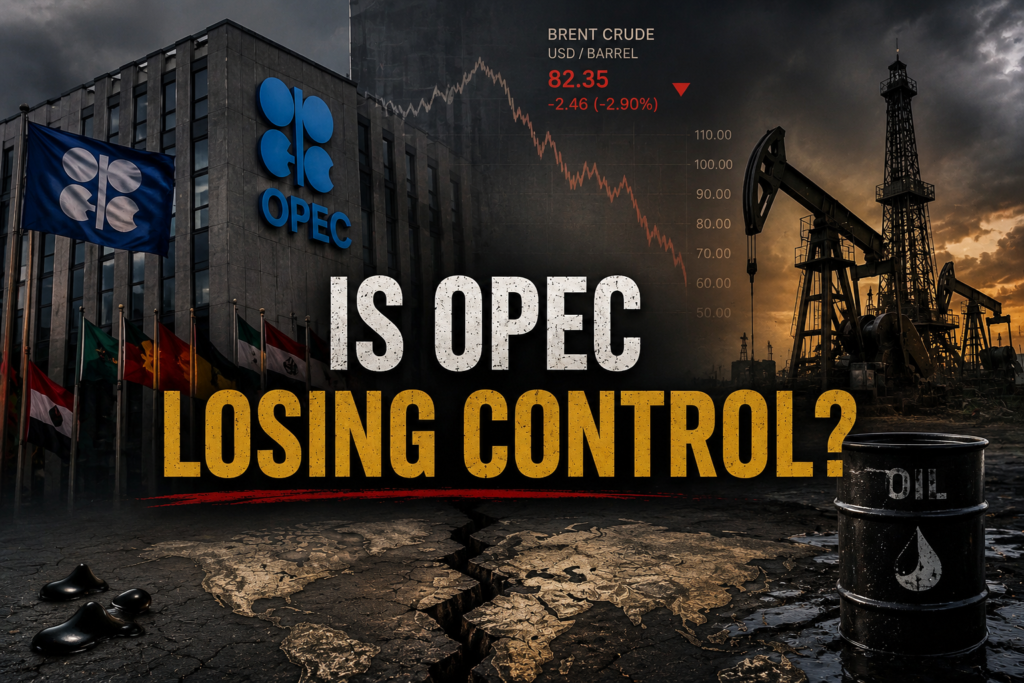
Is OPEC Actually Losing Control?
It’s tempting to answer yes.
The evidence certainly points to a more constrained organization than the one that dominated headlines decades ago.
The United States transformed global energy markets through shale production. Brazil, Guyana, and Canada have significantly expanded output. More producers now have meaningful influence over global supply, reducing OPEC’s ability to shape prices on its own.
Financial markets have evolved as well. Oil prices today react not only to production announcements but also to interest rates, currency movements, geopolitical risks, recession fears, and investor expectations. The market processes information far faster than it once did.
Control has become more dispersed.
Yet declaring OPEC irrelevant would miss an equally important reality.
Saudi Arabia still possesses spare production capacity that few countries can match. OPEC members collectively control a substantial share of the world’s proven oil reserves. Their decisions continue to influence market expectations, even when they don’t fully determine prices.
Perhaps the better question isn’t whether OPEC is losing control.
Perhaps it’s whether control itself has become a less useful way to describe today’s energy market.
No single institution—whether OPEC, the United States, or even major financial markets—can dominate an increasingly interconnected system on its own.
Why This Matters Beyond Oil
Oil prices influence far more than energy companies.
Lower prices generally benefit importing economies like India, Japan, and much of Europe by reducing energy costs and easing inflationary pressure. Airlines, shipping firms, logistics companies, chemical manufacturers, and countless industrial businesses also gain when fuel becomes cheaper.
For exporters, however, the picture looks very different.
Sustained periods of lower prices can force governments to postpone infrastructure projects, borrow more aggressively, trim public spending, or delay economic reforms. The same price movement that helps consumers filling their cars can create difficult budget decisions thousands of miles away.
Oil is one of the few commodities where the winners and losers often sit on opposite sides of the same headline.
That explains why debates inside OPEC attract attention well beyond the energy industry.
Why India Should Watch Closely
For India, the stakes are practical rather than theoretical.
The country imports most of the crude oil it consumes, making international prices an important factor for inflation, the trade balance, and the value of the rupee.
Lower crude prices can reduce import costs and ease pressure across large parts of the economy. Businesses that depend heavily on transportation or manufacturing often welcome that relief.
Still, international prices tell only part of the story.
Domestic fuel costs also reflect taxation, refining margins, exchange rates, transportation expenses, and government policy. A decline in global crude doesn’t always translate into an immediate drop at the fuel pump.
Even so, sustained shifts in oil markets eventually work their way through the broader economy. Investors know this. Policymakers know it. That’s one reason OPEC meetings continue to command attention despite all the changes in the energy landscape.
The Bigger Story
The most interesting part of this debate may not be OPEC itself.
It’s what OPEC increasingly represents.
For much of its history, the organization symbolized an era when relatively small groups of countries could shape global markets through coordinated action. Today’s world is more fragmented.
Technology has reshaped production. New exporters have emerged. Renewable energy continues to expand. Electric vehicles are gradually changing patterns of demand. Geopolitical rivalries now influence energy policy almost as much as economics does.
Power hasn’t disappeared.
It has simply become more distributed.
That broader shift extends well beyond oil. International trade, manufacturing, finance, and technology are all becoming less concentrated than they were a generation ago. Influence today depends less on commanding the market and more on adapting to it.
OPEC has survived wars, financial crises, dramatic price collapses, and major geopolitical upheavals. It would be unwise to underestimate its ability to evolve again.
At the same time, Iraq’s latest challenge is a reminder that maintaining unity is becoming more difficult as member countries face increasingly different economic realities. Those pressures won’t disappear after the next meeting or the next production agreement.
They are structural.
Whether OPEC ultimately becomes a stronger, more flexible alliance or gradually loses some of its influence will depend less on a single quota dispute than on how successfully it adapts to a world where energy power is no longer concentrated in one organization.
In many ways, that may be the real story unfolding here.
The debate inside OPEC isn’t simply about barrels of oil. It’s about how global influence changes when the world itself becomes less centralized. Oil just happens to be where that transformation is easiest to see.